The Ultimate Inclusive Content Marketing Guide: Download Now
Learn how to create content that reaches your widest audience yet.


Every year, National Inclusion Week takes place in September; this is typically seen as a week to focus on inclusion in workplaces and communities across the UK, particularly on the topic of disability, and breaking down access barriers for Disabled people. This year, from 15th – 21st September, the celebration will have the theme of ‘Now is the time’.
When it comes to a marketing perspective, however, how can we ensure this actually happens – how can we remove those barriers? And what proactive ideas can be implemented as to the inclusion of Disabled people in particular?
In this piece we have explained why the inclusion of Disabled people matters, as well as the benefits of doing so – along with some ideas that companies and brands can implement in-house too to join National Inclusion Week this year (and future ones too!).
If you have been in the DEI space, you may have heard the term ‘the curb cut effect’; this is one of the many examples that demonstrates why inclusion of disability matters, to the benefit of all, particularly in the areas of design, art and culture.
Imagine there is an entrance with a step into your local coffee shop. A wheelchair user should still be able to independently access the building, solo – not every Disabled person has a caregiver on hand at any given time. In order to do so, they will need a ramp to be able to wheel into the shop. However, this new access afforded by the ramp will also be of assistance to other people – including non Disabled individuals. A mother struggling with her baby in a pushchair, an elderly man just out of surgery, among many others – the ramp benefits everyone, regardless of whether or not they may be disabled.
This is what the curb cut effect describes – inclusion being something for everyone, to the benefit of all. We see this in the arts, design, technology – from electric toothbrushes to touchscreen technology. You have a Disabled person to thank for both of these two examples!
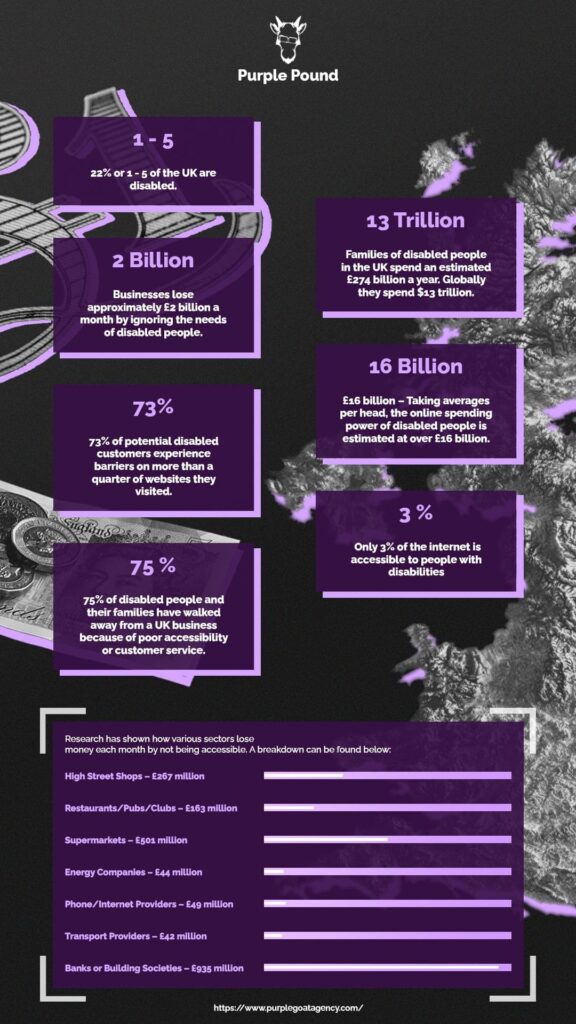
The Purple Pound is the total spending power of all Disabled households across the UK; this is estimated to be worth approximately £274 billion. Disability is also on the rise; according to the last government census, almost a quarter of the UK’s population are Disabled. Yet, when you take into account that an estimated £2 billion is lost each month by ignoring the needs of Disabled customers and consumers, we have to ask ourselves as to whether we can ignore inclusion. The full report can be viewed here.
Generally, the ‘face’ of disability is more likely to be female, along with a significant rise in Gen Z individuals. True inclusion means access to this ‘pie’ for businesses, along with fulfilling basic obligations (such as reasonable adjustments) in law. This economy of people is largely untapped – and is there for the taking.
Disabled individuals face a myriad of barriers into and at work, despite being qualified for the position. For example, when you cannot access a building, due to no ramp being available for a wheelchair. In the application process of looking for employment, alternative forms may be needed – i.e such as if someone has a visual disability – as well as when it comes to interviews. Remote interviews need to consider captions being a default option.
Purple Goat Agency offers in-house training for companies which everyone should take advantage of!
Disabled people are the experts in the room – and they can always assist when it comes to inclusion! Their lived experience avoids tokenism and lipservice being paid to inclusion from the get-go.
There are plenty of consultants who can assist when it comes to working in DEI. Plus, there is also the added benefit of ‘brand retention’, loyalty to customers and consumers will always be returned.
If there is a form, whether that is for feedback, to apply for a job, or just to contact your team, this will not be accessible to certain individuals in many cases. An Autistic person may struggle to process lots of information at once, unless questions are broken down into plain, simple English.
This then becomes a barrier – because how can anyone get around that? Think about the format of forms and how they are presented; is there anything you can do better? Better still; take advantage of point two to solve this issue.
Think further afield, too; how accessible is the content of your website and your social media channels? You can check our articles on Instagram, YouTube and TikTok accessibility to learn how to foster inclusion of Disabled audiences.
If ever there is an in-house meeting or a job interview, providing questions or agendas beforehand – with ample preparation time – will be of assistance. It allows people to be at their best, and to work around potential barriers; plus, there is also the advantage of increasing productivity by saving time, too.
Allowing for honest and open feedback means to continually be on top of inaccessibility, as well as fostering a healthy environment for a company; what’s not to love about that? Make sure to be proactive and to actively listen to foster a safe environment.
The Covid 19 pandemic meant we all began to work from home, something that Disabled people had historically been asking for, especially when it came to the right of remote access. Yet, there can be other structural changes to make; a four day working week has been shown to improve productivity, for example. This may be worthwhile investigating further. Four day working weeks are growing in popularity, and some research also suggests that this increases productivity, too.
Disabled people are the world’s largest minority group; inclusion can also come from celebrating employees, by way of creating a safe, friendly environment. If your company celebrates other cultural days, why not celebrate Disability Pride Month, or even International Persons With Disabilities Day? It’s a way to make people feel included, by celebrating them, after all!
Email signatures can tell a lot about ourselves and our company; they can also be used to spell out access needs, along with setting of hours, deadlines, and more. This is a way to foster inclusion, as well as setting boundaries – all for a good cause.
Sometimes a basic barrier can be eradicated very simply; not everyone can ‘perform’ as part of phone calls, such as when it comes to being Deaf or Autistic. So, a very simple gesture is to have an email address available – separate from ‘info!’ – and to make this available easily.
And remember, National Inclusion Week might just be seven days, but your diverse audience and employees exist during the other 51 weeks of the year! Long-term commitments will make sure your company grows, thrives and becomes a good environment for your teams. If you’re building a year-round inclusion calendar, you’ll also want to know how to celebrate Disability History Month, which runs from November into December each year.
Would you like to learn more about how your brand can become more inclusive through both internal and external practices? Contact the team at Purple Goat today and start your inclusion journey!
What else would you like to see for this inclusion week? Let us know in the comments below!