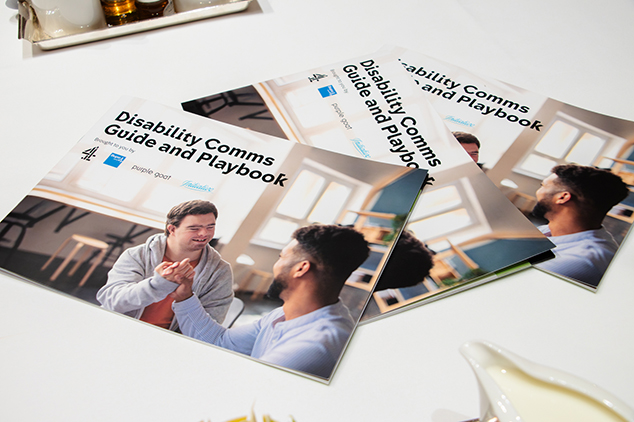
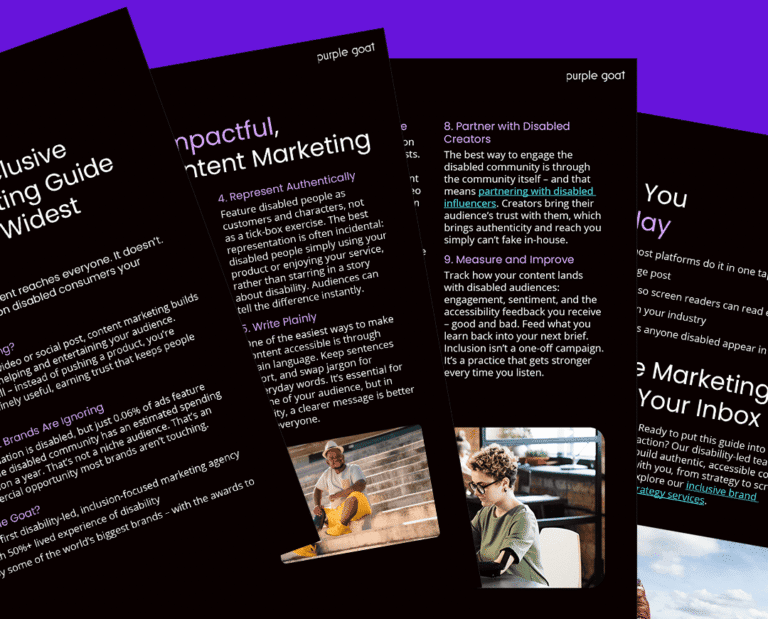
The Ultimate Inclusive Content Marketing Guide: Download Now
Learn how to create content that reaches your widest audience yet.

Search engines and audiences increasingly favour brands that communicate clearly and with inclusion in mind. Yet even highly experienced marketers can struggle to keep up with the evolving language of diversity, equity and inclusion (DEI).
But don’t fear, what you need is the perfect team of inclusive marketing experts to help you!
This DEI glossary will provide you with a comprehensive, marketing-focused overview of essential DEI terms, helping brand leaders and marketers communicate clearly, avoid missteps, and embed inclusion at every stage of the creative process.
Whether you’re looking to develop inclusive campaigns, briefing creative teams, auditing brand assets, or shaping long-term strategy (where inclusion can be your strongest point), understanding DEI terminology is fundamental.
While you might know the incredible value of DEI in marketing, others might still be reticent about introducing it into their media plans.
However you feel about it, it’s important to understand that DEI is not just a cultural expectation anymore, it’s a business imperative. Consumers consistently reward brands that demonstrate authentic representation and penalise those that exclude, misrepresent, or stereotype communities. Research continues to show that audiences are more likely to trust, buy from, and advocate for brands that reflect their values and identities.
Disability inclusion, in particular, is a growing commercial priority, with Disabled consumers often excluded from mainstream marketing and product design despite being part of an $18 trillion global market.
It seems like a no-brainer, inclusive brands will grow, while non-inclusive brands will fall behind.
Inclusive marketing and DEI bring growth to businesses when done right. We’ve seen that inclusive brands are:
Marketers who understand DEI and inclusive marketing principles can create campaigns that speak to more people, resonate more deeply, and foster long-term loyalty!
This glossary is designed as a resource for marketing teams at every stage of their inclusive journey.
This resource is ideal for:
Discrimination against disabled people. This can be behaviours, language, systems or assumptions. It can be direct (like using slurs or refusing to hire someone based on their disability) or subtle (like having stereotypes in marketing, using infantilising language or a lack of accessibility)..
The degree to which environments, content, products or services are usable by as many people as possible, including disabled people. This relates to both online and offline environments. For brands, this might include accessible social media, accessible websites, and events with everyone’s access needs considered.
See also: Accessible social media.
A commitment to acknowledging mistakes, addressing harm, and making genuine commitments and improvements. This is critical for brands striving for long-term inclusive integrity.
Adjustments or support provided to ensure equitable and fair access to everyone. For example: providing live captions, offering alternative formats or designing flexible event experiences.
Actions taken to actively support equitable treatment, accessibility, representation and inclusion of a community or group.
The ongoing practice of using one’s influence to support marginalised groups. Effective allyship is action-oriented, not performative, and involves listening, learning, speaking up, and celebrating those communities.
A sense of psychological safety and acceptance. Belonging is the outcome of sustained DEI work, not a standalone initiative.
Internalised attitudes, stereotypes or assumptions that influence decisions.
In marketing, bias affects casting, storylines, imagery, language, and segmentation.
A framework for building fair, representative and inclusive environments. It can apply to any industry or workplace.
Extensions of DEI (see above) incorporating either Accessibility (DEIA) or Belonging (DEIB) to ensure more holistic practices.
Unequal treatment of a person or group based on their race, gender, disability, etc. In marketing, discrimination can appear through exclusionary targeting, harmful stereotypes or inaccessible communication.
The presence of different identities and lived experiences, including disability, ethnicity, gender, sexuality, and more.
Ensuring fair access and opportunities by addressing systemic barriers. Equity is different to equality as equity acknowledges different starting points.
Language that avoids assumptions about gender. Examples include using “they/them” for unknown genders.
Ensuring diverse groups are welcomed, valued and able to participate meaningfully.
Design that considers access needs and can be enjoyed by everyone, including Disabled people.
A framework describing how different identities (e.g., disability + race + gender) intersect to create unique lived experiences.
Knowledge that comes directly from life experiences, usually associated with a protected characteristic, like race, sexuality or disability.
Person or group of people who face discrimination or exclusion, usually connected to their lived experiences.
Subtle, often unintentional comments or actions that reinforce stereotypes or cause harm, usually aimed at those from marginalised groups.
The idea that cognitive differences such as ADHD, autism, dyslexia and others are part of natural human brain variation.
Someone whose brain processes information differently compared to what is considered typical. If someone is neurodivergent, they are usually autistic, dyslexic, have ADHD, or other neurodivergent conditions.
Including different groups so they can feel represented. When it comes to marketing, this can be on TV ads, social media campaigns or e-commerce. Representation must be accurate, diverse and non-tokenistic.
An environment where people feel free to express their identities without fear of discrimination or judgement.
The practice of doing something with the only purpose of avoiding criticism and giving an alternative appearance. Something is tokenistic when the action is not followed by a true intention behind it.
Understand more about tokenism and the impact in marketing in our article here.
Design that is usable by all people regardless of disability.
A community that is inadequately represented in media, marketing, leadership or decision-making spaces.
Practices that enable employees of all identities and lived experiences to feel valued, heard and empowered at work.
An umbrella term for Black, Indigenous and People of Colour, highlighting their histories and experiences, often used to show how these groups have been severely impacted by systemic racial injustices.
The adoption or use of elements from a minority group by a majority group or culture without permission, understanding or respect, doing it in an exploitative, disrespectful or stereotypical way.
To have meaning within a culture. Content that aligns with the lived experiences, histories and values of specific cultural communities. In marketing, this means avoiding stereotypes and demonstrating authenticity.
Judging other cultures by the standards of one’s own, leading to negative or incorrect representation and beliefs.
A situation in which minorities collectively form the majority within a population.
Fear or prejudice against foreign people.
An acronym for lesbian, gay, bisexual, transgender, queer/questioning, intersex, asexual, plus other identities.
The assumption that heterosexuality is the default orientation in society.
A gender identity that does not fit solely into male or female categories.
Discrimination or bias based on age, often impacting older adults negatively.
Faith-Inclusive Language
Respectful language that recognises diverse religious identities and practices without assuming default beliefs.
Designing environments, campaigns and products that work for people across different age groups.
Considering affordability, digital access, education levels and other economic factors that influence how people interact with brands.
Advantages that individuals may receive due to their socioeconomic status.

Inclusive communication is an important part of inclusive marketing. It shapes brand voice, customer relationships, and the accessibility of content across platforms. For guidance on disability-inclusive language specifically, check out Purple Goat’s guidelines.
Some terms have become outdated, inaccurate, or harmful due to their historical associations or wrong stereotypes. Some examples include:
Better alternatives include:
The goal is respect and alignment with how communities describe themselves.
Additional helpful resources from Purple Goat:
Purple Goat is the world’s leading disability-led inclusive marketing agency. We partner with brands to embed DEI across every stage of marketing, from strategy and insights to creative campaigns and social media content.
Through DEI consulting, industry training, inclusive creative, and lived-experience-driven insights, we help brands build authentic representation and unlock the $18 trillion spending power of Disabled consumers in the world.
If your organisation wants to enhance brand trust and reach more audiences 👇