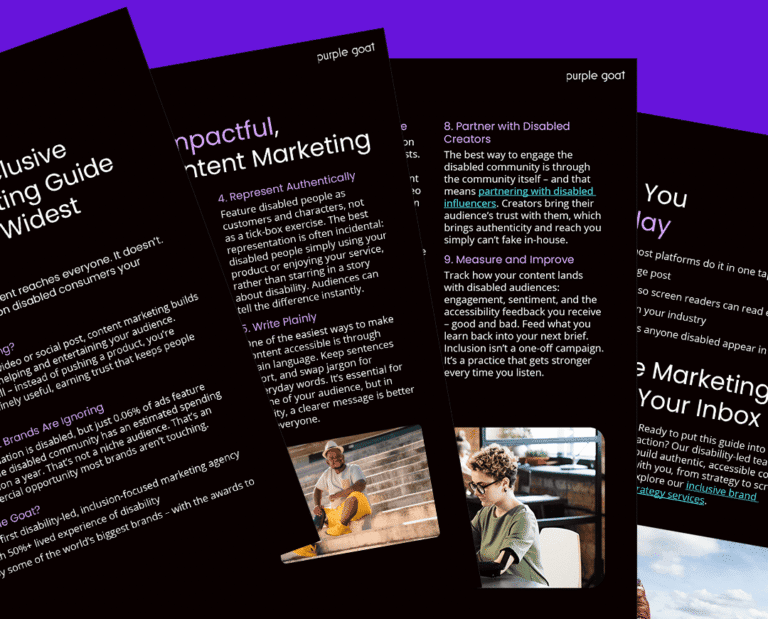
The Ultimate Inclusive Content Marketing Guide: Download Now
Learn how to create content that reaches your widest audience yet.


Marketing nowadays doesn’t fail because of a lack of tools, data, or channels (we already have loads of those). It’s failing because too many brands are still thinking the same way they did ten years ago.
The brands that are really growing share something deeper than clever campaigns or sharp targeting. They share a marketing mindset rooted in empathy, inclusion, and a genuine understanding of people.
So, what type of mindset is best suited for digital marketing today? It’s one that’s inclusive, consumer-first, and designed for long-term value, not short-term wins.
In this article we’ll explore what the right marketing mindset looks like, why inclusive brands consistently outperform, and how shifting your thinking can unlock more meaningful, sustainable growth.
A strong marketing mindset isn’t about shouting louder or chasing every new trend. It’s about how brands think before they act.
The right marketing mindset prioritises:
In digital marketing especially, data is a big buzzword, but true success comes from understanding that people are not just data points. They are complex, emotional, and diverse, and a good digital marketing mindset should reflect that reality.
Transactional marketing asks, “How do we get the sale?”
Relationship-driven marketing asks, “How do we earn trust?” – which will in turn impact sales long-term.
Brands stuck in a transactional mindset often focus on performance metrics in isolation: clicks, impressions, short-term ROI. But growth-focused brands understand something more important: relationships compound over time.
A strong growth marketing mindset invests in experiences people want to return to, because loyalty, advocacy, and lifetime value are where sustainable growth lives.
When brands don’t evolve their mindset, the cracks start to show.
They struggle to:
In a world where people expect brands to understand them, exclusion, even when unintentional, becomes a growth blocker.
As an example, below is a clip from our episode on ‘How to Market to Neurodivergent Audiences Authentically‘, where our team gives you powerful insights and tips that go above simple representation and finding the right marketing mindset.
An inclusive marketing mindset means starting with the assumption that your audience is diverse, because it is.
It’s about designing marketing that reflects real life, real people, and real lived experiences. Not as an afterthought, but as a strategic foundation.
Inclusive marketing is explored more deeply in our article What Is Inclusive Marketing?, but at its core, it’s about recognising that inclusion drives relevance, and relevance drives results. If you want to learn more about what that could mean to your brand, you can contact the team here.
Many brands focus on inclusive messaging without the inclusive thinking beforehand. The result? Campaigns that look progressive but feel disconnected.
The reality is that true inclusion starts in insight, in strategy, and in decision-making. It shows up in who’s considered, who’s consulted, and whose needs shape the final output. Without the right marketing mindset, even the best intentions can fall flat.
Traditional marketing often relies on narrow “ideal customer” profiles that don’t reflect reality. For brands that want to market to their real audience, they should be asking themselves:
Disabled consumers, for example, represent a significant market that is still widely underserved (24% of the UK population, and a spending power of £274 billions every year). We explore this in more detail in our insights on disabled consumers.
Inclusive marketing is often misunderstood as:
In reality, none of those are true. Inclusive marketing is one of the clearest ways brands can future-proof their growth.
You can watch our podcast about common misconceptions below…
Or explore our free resource ‘Inclusive Advertising: Common Pitfalls and How to Avoid Them.’
People increasingly choose brands that reflect their values and experiences. Research from Cardiff University shows that inclusive advertising, particularly disability representation, can significantly boost brand loyalty and social impact.
When people feel seen, they engage more deeply AND stay longer.
While data is incredibly important, it’s important to remember that a consumer-first marketing mindset moves beyond surface-level data.
It looks at:
This deeper understanding allows brands to create marketing that feels relevant, respectful, and genuinely useful.
Trust is built when people feel understood, and inclusive brands earn trust by consistently showing up in ways that feel authentic and human.
Our article on the importance of inclusive marketing highlight how this trust translates directly into loyalty and long-term brand value. Make sure to check it out!
By designing marketing that works for more people, inclusive brands will naturally expand their reach.
And they don’t just acquire customers, they build advocates. And advocacy is one of the most powerful growth drivers available to modern brands. If someone feels truly seen and understood, they will make sure to share their positive experience with everyone around them.

The strongest digital marketing mindset uses data to find gaps in areas like accessibility, unmet needs or targeted groups. When used in the right way, data becomes a tool for better experiences, not just better targeting.
An inclusive mindset challenges bias and assumptions during the whole campaign process. The goal is to personalise responsibly, ensuring digital marketing works with the community in mind and in the room.
Every digital touchpoint sends a message about who a brand is for. Accessible, inclusive experiences signal understanding and belonging, and belonging is one of the strongest emotional drivers of loyalty in a digital-first world.
A truly inclusive marketing mindset can’t live in silos. It needs support from everyone, from leadership, product and campaigns to customer experience teams. When inclusion is embedded across the organisation, it shows up consistently and credibly.
The most effective brands align teams around a shared purpose: delivering meaningful value to people.
This alignment shifts focus away from short-term wins and towards sustainable, consumer-led long-term growth.
Diverse perspectives lead to better decisions. Brands with diverse groups reduce risk, increase relevance, and create work that resonates more widely.
This is also where strong commercial returns emerge, you can read more on this in our ROI of diversity and inclusion or watch our podcast episode on this topic below.
Performance metrics are important, but it’s even more important to look at the right ones.
Inclusive brands look at:
These signals reveal how marketing is experienced, not just how it performs.
Retention and advocacy are powerful performance indicators. Inclusive brands often see stronger lifetime value because people stay and recommend the brand to others, this is especially true for groups like the Disabled community.
The key after reading all the above is that when success is measured holistically, inclusion becomes clearly linked to growth, and brands should really be paying attention.
Inclusivity is no longer optional. The brands that thrive will be those that listen, adapt, and design with ALL people in mind.
If you’re serious about taking your marketing to the next level, an inclusive marketing mindset is where change starts.
Purple Goat helps brands embed inclusive thinking into every part of their media plans, from brand strategy, digital campaigns, and social media content, unlocking growth by designing marketing that works for everyone, including the Disabled community.