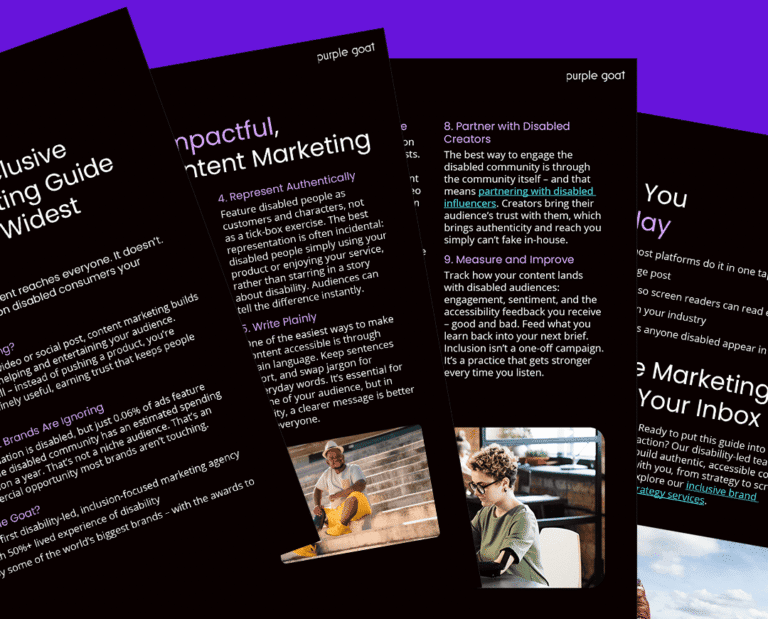
The Ultimate Inclusive Content Marketing Guide: Download Now
Learn how to create content that reaches your widest audience yet.

What is the ROI of inclusive marketing? We know brands have lots of questions about it, so this episode will hopefully answer most of them.
Join our Strat Team and a special guest ‘ROI Roy’, who will be asking all the tough questions. From knowing if your brand has any disabled customers, to making inclusion work for different ad formats, and how to make your teams get it.
You don’t want to miss it.
If you want to learn more, reach out to the inclusive marketing experts creating award-winning campaigns at Purple Goat.
[Transcript below]
ROI Roy:
Yeah, I don’t really buy it.
Josie Choy:
What don’t you buy?
ROI Roy:
Inclusion.
Josie Choy:
Inclusion?
ROI Roy:
Yeah. I’m not really into that. I’m kind of too cool for inclusion and that’s kind of my thing. I manage various brands and I just think disability is a bit niche.
Josie Choy:
A bit niche?
ROI Roy:
Yeah.
Josie Choy:
I mean, I think that’s a huge misconception around disability really. And yeah, the disabled community, they make up like 24% of the UK population. One in four people are disabled. The disabled community is the largest minority in the world.
ROI Roy:
Is that true?
Josie Choy:
I wouldn’t say that’s niche. Disabled creators outperform non-disabled creators by 20.6%.
ROI Roy:
I don’t feel like disability would be the kind of right sort of theme for them to jump on the bandwagon of and too right I’d say.
Josie Choy:
It’s not about necessarily being purpose led. There’s obviously brands out there that having a purpose is a huge part of who their brand is. It’s about people. It’s about being relevant to your audience.
Josie Choy:
Hi guys, welcome to The Purple Goat Podcast. I’m Josie, Strategy Director at Purple Goat. I’m here with Bill.
Bill Urquhart:
Hello.
Josie Choy:
And today we’re talking about the value of inclusive marketing.
Bill Urquhart:
Now, when we were coming up with the kind of idea for this podcast, we were thinking about what makes a great podcast. And actually we realised that often the most entertaining thing is to have people with different opinions come together and marry those opinions somewhere in the middle and have an interesting discussion.
But being at Purple Goat, being both within actually the same team, the strategy team, and working very closely with each other, we realised we’re actually very much on the same side of the court in most areas and fields. So we thought it could be an interesting exercise to invite a theoretical guest onto the podcast.
He may look a little bit familiar, but hopefully not too familiar. He certainly will be fictional, but he will be a strong presence, I’m sure. Without further ado, I think I should welcome him on. So I’ll go and swap out. Thank you.
ROI Roy:
Hello everyone. I am ROI Roy, AKA, Return On Investment Roy, AKA, ROI ROY, and I’m excited to be here.
Josie Choy:
I’m excited to have you here. I hear you’re a little bit of a sceptic.
ROI Roy:
Yeah, I don’t really buy it.
Josie Choy:
What don’t you buy?
ROI Roy:
Inclusion.
Josie Choy:
Inclusion?
ROI Roy:
Yeah. I’m not really into that.
I’m kind of too cool for inclusion and that’s kind of my thing. I mean, I’m not really here to be persuaded, but you’re very welcome to have a pop, I suppose.
I mean, where do I start? I mean, the first thing that I think is very obviously a concern of mine. I manage various brands and I just think disability is a bit niche.
Josie Choy:
A bit niche?
ROI Roy:
Yeah.
Josie Choy:
I mean I think that’s a misconception around disability, really. And yeah, the disabled community, they make up like 24% of the UK population. One in five people, or one in four people are disabled. So the disabled community is the largest minority in the world.
ROI Roy:
Is that true?
Josie Choy:
I wouldn’t say that’s niche.
ROI Roy:
Is that true?
Josie Choy:
Yeah. See gov.uk.
ROI Roy:
Gov.uk. Are you going to provide sources throughout this podcast?
Josie Choy:
I don’t, don’t have that many sources, but I might out of memory have sources.
ROI Roy:
Okay. I mean, that’s quite a staggering statistic.
Josie Choy:
Yeah.
ROI Roy:
It still feels niche though. I mean, you don’t see many brands doing it.
Josie Choy:
No, you don’t. And that is a challenge that we often face.
Only 0.06% of (TV) ads actually feature disabled people. However, when you compare that to the 16 million disabled people living in the UK, and that actually 24% of the population are disabled, there’s a huge disparity there, and that there provides those brands you work with a huge growth opportunity to kind of expand their audience and meet much more relevant customers potentially.
ROI Roy:
Okay. I kind of see your point.
I guess one issue that definitely springs to mind for me is a lot of the brands that I work with don’t really feel very purpose led. They don’t feel like disability would be the kind of right sort of theme for them to jump on the bandwagon of and too right, I’d say.
Josie Choy:
It’s not about necessarily being purpose led. There’s obviously brands out there that having a purpose is a huge part of who their brand is, but it’s about people. It’s about being relevant to your audience. And we know that disabled marketing, inclusive marketing performs incredibly well.
ROI Roy:
How well?
Josie Choy:
I mean if you just look on social, for example, disabled creators outperform non-disabled creators by 20.6%. So we know that people want to see more inclusive marketing.
There are loads and loads of stats out there that kind of showcase how brands, particularly like Gen Z and millennial audiences, want to see more inclusive marketing, want to see them and the people around them representing in the comms they’re consuming. And so therefore, we know that when people and brands do inclusive marketing, when they have that kind of representation on screen, it’s received really well.
ROI Roy:
I mean that seems quite like a broad statement. Do you think that’s going to be true for my audience?
I mean, for instance, one of the brands I work on is to do with extreme sports, and mainly motorcycles. Do you think that would be relevant for my audience specifically? I don’t imagine there were that many disabled audiences that I’d be talking to.
Josie Choy:
Why not?
ROI Roy:
I don’t see them?
Josie Choy:
Yeah. I mean you’ve got to remember that not all, I think there’s this huge misconception that all disabled people are wheelchair users, whereas actually loads of disabled communities, they actually have hidden disabilities or it’s like neurodiversity. You don’t actually see it yourself.
And when you look at your audience, it could be that you don’t have, you are not appealing to disabled consumers, but also you’ve got to remember that actually when it comes to data, a huge problem we find that is there’s a huge data gap when it comes to disability and that people don’t ask if people are disabled, they don’t segment it and therefore they just don’t have that data.
And statistically is very likely that some people within your consumer base are disabled, and you are not just not talking to them directly.
ROI Roy:
So am I supposed to just gamble on this assumption that they will be there?
Josie Choy:
No, you can do insights. You can find out about your audience. You can speak to people, how your brand can better tailor their comms to meet their needs and what the people actually want to see.
ROI Roy:
Interesting. Okay. I’m with you so far. I wouldn’t say I’m bought in yet, but it’s certainly an interesting conversation. Never heard it spelled out precisely like this.
One thing that I have seen a lot of and I’m deathly fearful of is being cancelled. I tread pretty close to the line. I’m pretty hardcore and I usually teeter a little bit over the edge in terms of what I do and how hardcore I go. I don’t want to be called out. I don’t want to be doing something with my marketing that is perceived as going wrong and I don’t want be cancelled. How do you explain that?
Josie Choy:
I think a lot of people, I think a lot of brands steer away from featuring disability with the fear of getting it wrong. I think getting it wrong is a genuine concern, and I think if you do it authentically, it can go incredibly well.
But also arguably you’re taking a huge risk not doing it. More and more brands, more and more people I mean, they want to see themselves and the people around them represented in their comms. And we know that actually a lot of consumers, there’s so many options out there for them that they’re being more and more value driven. So you’re taking a bit of a risk doing nothing we’d say.
ROI Roy:
So my silence is more of a risk than taking the perceived risk. Is that your point?
Josie Choy:
Yeah, potentially.
ROI Roy:
Interesting. And I mean beyond just including disabled people in my extreme sports ads, what am I supposed to be doing?
Josie Choy:
I mean, disability is an intersection. We’re not just talking, we’re talking about inclusive marketing. It’s not just disability inclusion.
Yes, we’re Purple Goat, but obviously there’s so many other communities that you should be representing in your comms and potentially speaking to that you’re potentially not currently doing so far.
ROI Roy:
So I should be reaching out to these people and understanding..what’s the process I suppose I’m asking.
Josie Choy:
Yeah, I mean you could definitely start with insights. I think that’s a really good place to start to know.
We often do at Purple Goat insights with disabled creators, and that means we get really rich insights from those communities on how they best want to be served, what’s relevant to them, what’s not relevant to them, and how they best want that communicated to them.
And I think that’s a really good first initial stepping stone without having to put loads and loads of budget to this huge comms activity that you, as you said, could potentially go wrong.
ROI Roy:
Yeah, I mean, I guess you kind of touched on that point there, but Cashola is a big motivator in what I call the money factory, my business. How much is this all going to cost?
Josie Choy:
What do you mean?
ROI Roy:
It sounds expensive. I’ve never done it before. It sounds like if I have to build it from the ground up and do all this insights into brand new campaigns or reversion my old stuff, it feels like something that is just, is it going to be expensive?
Josie Choy:
You don’t have to revamp it all at once, to do it actually authentically, you’re better off taking smaller steps anyway, really.
So I think you can start off by building in inclusive activity, cast in accessibility considerations early on in your briefs, your planning and starting kind of consulting with disabled people at the very start of your campaign or planning, whatever it may be. You’ll save loads more budget at later down the line, and you’ll definitely see the performance and results later.
ROI Roy:
Okay, so there is a good ROI.
Josie Choy:
Yeah.
ROI Roy:
That is incredibly reassuring. I can’t overstate that fact.
Josie Choy:
I mean, there’s loads of brands out there that have reports saying that it drives innovation, it drives customer retention, customer attention, customer loyalty, and you’ll get way more click through on your content. Better engagement sentiment around our campaigns is definitely something we find in our campaigns at Purple Goat when we do inclusive marketing.
ROI Roy:
I mean, yeah, performance marketing is gospel to me. And in terms of creativity, because I see creativity as my lifeblood, I need to have creativity flying through my veins at all hours of the day. It’s just how I function. Does representing disability and other marginalised communities in my advertising, is that going to hinder that? It seems like it might.
Josie Choy:
I would absolutely disagree.
I think it sharpens your creativity in a way. I think one, because people don’t see it, they don’t see disabled representation, whether they’re scrolling on social watching whatever it may be. It is scroll stopping content, something that’s totally, totally new to them.
But also when you think just inclusively and baking in all those accessibility considerations early on, early days and your content is way more accessible, more people are watching it, more people can consume it. And it just also means, I think there’s this misconception around accessibility inclusion that is just for disabled people. It’s just for a set community, and actually it benefits everybody.
There’s so much insights actually, most people watch their kind of reels or tiktoks with captions on, so you kind of bath that inclusivity early on I think you’ll find that it’ll sharpen the execution of your creatives, whatever it may be.
ROI Roy:
That’s great. I mean, do you have any examples that spring to mind of great creativity that have come out of disability inclusion?
Josie Choy:
I mean, it’s easy then to speak about case studies we’ve had at Purple Goat, and I think one really good example is Strongbow in the sense that they came to us wanting to be the most inclusive drinks band out there and they had this huge rebrand and they obviously, British humour is who they are and it’s a huge part of their kind of branding.
And we just took that little bit further by making sure their activations are inclusive, they’re accessible, but any sort of events they have, like BSL interpreters, it was all really fun. It’s all really kind of on brand, but not all kind of dull kind of disability stuff that you may presume. I think it was kind of out of the box kind of stuff that people aren’t used to seeing, but also still breathe life into their activity that year.
ROI Roy:
That’s really interesting. So was that kind of integrated with wider comms? I mean, I’m really interested in the, I suppose the possibility of the kind of intersectionality between say a disabled focused, disability focused strand of content versus your business as usual stuff and how that blends in, whether or not they’re kind of water and oil and kind of repel each other and can’t merge or whether you have to do it all disability focused. I mean, what’s your kind of stance on that? I
Josie Choy:
I think generally speaking, it is going to come across a little more authentic if it’s built into your media plan and is kind of spread throughout all your activity, so that all your kind of activations, campaigns, whatever it may be, have that kind of inclusive flavour sprinkled across all of it, as opposed to having a siloed tokenistic kind of standalone campaign by itself.
And there’s really easy ways that you can do that. It’s not, what we do at Purple Goat is kind of consult and inform people on how they can best fit inclusion and inclusive thinking into their media plans and their activities to ensure that they’re doing in a way that feels natural for the brand, but also speaks to all those kind of relevant audiences.
ROI Roy:
But you’re certainly saying you don’t have to do that overnight, right?
Josie Choy:
No, no, no, absolutely not. I think if anything, that’s a huge misconception that you’ve got to do it all together.
I think one, it’s a lot easier, cost efficient, but also you are more likely to get it right if you kind of try and test what works for your brand as well.
So yes, there’s insights, but also quite typically a Purple Goat will do an influencer activation and because it’s totally new for that brand, we’ll start off, let’s say test budget, and we try that and then it’s once they see all the incredible results that’s brought, they’re like, yeah, okay, we need to put more into this. We need to make sure that we’re aligning this with that brief, making sure that we’re putting more disabled creators in places where our other creators are.
ROI Roy:
Right. And so how does that work? Do you kind of have budgets set aside for inclusive media spend in the sort of regular pot elsewhere, or how does it work?
Josie Choy:
It can work either way. I think for some brands it’s useful to know that they’re putting X amount towards inclusive marketing, and keeping themselves accountable in that way and making sure that they’re making sure that they’re kind of handling it that pot and making sure that they’re specifically attributing that to disabled creators or inclusive marketing, whatever means that takes.
But we definitely work also where we’re just taking a slice or we’re just activating both disabled and non-disabled creators together, and we kind of manage those splits, making sure that in terms of all the influences we’re activating, we make sure that a good portion of those are inclusive and diverse.
ROI Roy:
And that performs better presumably than the..
Josie Choy:
Yeah, I mean, generally speaking, inclusive marketing performs brilliantly. And I think if anything, if you have one distinct creator that you want to put out there, it works really well if you just slightly tailor it to say, well community, but don’t have a whole new creative for them.
You want one strong, really clear brand message. Obviously there’ll be cases where that’s not the case, but generally speaking. Yeah.
ROI Roy:
Interesting. Okay.
And so let’s say I’m kind of warming to this idea. One thing that has crossed my mind is my team doesn’t feel equipped for this kind of task. Obviously we don’t really have any disabled people in the team. We’re all white men. How do we go about doing this right? It doesn’t feel like, although you’ve articulated some first steps that we could do going to the community, I mean, what does that even look like for me?
Josie Choy:
Well, I mean, if you’re not equipped, you’ve got to equip yourself.
So whether that’s working with disabled consultants or working with agencies like Purple Goat to make sure you are kind of getting that expertise in early days, I think that is a really great way to start making sure that you are building something with a really strong foundation.
But also in terms of getting the community, we often work with creators. So I think if you’re going to do a creator campaign or disabled creators and you are not sure whether your brief or your creative is going to fit or resonate with that audience, that’s something you can ask them. And making sure you are giving creators enough creative freedom to put their own twist on it to make sure it actually is going to sit right with them.
There’s no point asking people to do something without any flexibility and therefore it just not land because there’s nuances around disability that you’ve just totally ignored.
ROI Roy:
Yeah, okay. That seems to make sense. We’ve spoken about influencer marketing, there are obviously some ad formats out there that are more easily made accessible, more easily made inclusive. They each come with their kind of unique challenges.
Influencer marketing is quite clear. There is a way to move forward and have better representation, use disabled talent presumably. What about stuff where perhaps my brand has really stringent brand guidelines about what needs to be included in an ad? Maybe there’s a kind of a five second un-skippable YouTube ad. How do we go about making that as inclusive and accessible as possible when we’ve got already cramming so much into such a short period of time? You know what I mean?
Josie Choy:
Yeah, I mean, I think it’s having different aversions of things, and I don’t think every single placement of your activity necessarily has to have a wheelchair user on it. It’s about balance and it’s making sure that you’re putting enough budget towards your media plan that does talk to accessibility and inclusion.
I don’t think every single placement, if you think about out of home, not every single placement is accessible, but there’s some brilliant, brilliant brands that have done things that are not necessarily influencer marketing, but are incredibly, I think, resonate incredibly well, with the disabled community.
So if you’re talking about YouTube ads, there’s definitely ways in which you could have different versions of the ads that perhaps talk more to a disabled audience, to ones that perhaps your more typical audience, whatever that may be.
ROI Roy:
That’s great. So I mean, going briefly back to budget, because if we’re talking ROAS, which I often am, my ad spend is incredibly important, and we touched on it already, but I want to go back to the point of retrofitting versus involving people from the start.
I’ve got a lot of wheels in motion. I’m a big plate spinner. I’ve got stuff going on. How do I suddenly involve inclusion? I’ve got campaigns planned for the next two years. If I involve you and have to reversion all this stuff, isn’t that just going to be expensive?
Josie Choy:
Well, I don’t disagree that having to retrofit everything is going to be a bit more expensive. But if you’ve got campaigns in the next two years, well bringing us in as early as you can is going to save you way more money later down the line.
So I think making sure you’re getting that expertise on early days, I mean it makes so much more sense because we’ve had so many cases, not to name names, where you’ve had a whole campaign built out and then they’re like, yeah, we want this to be super inclusive and we want this to be really super representative. And we’ve had to be like, there’s a fundamental element of that ad or campaign, whatever it may be, creative, that we know isn’t going to land and they’ve had to go back and change it all.
So we know that actually you bring in as an early days, we can kind of support in making sure your messaging is correct, making sure it’s as progressive as possible, making sure that representation actually aligns with your brand, that you’re not doing anything that totally is inauthentic and isn’t tokenistic, and making sure that ultimately you’re creating something that’s going to perform really well.
ROI Roy:
Okay, cool. That makes sense. So you can come in at any stage, you just prefer to come in as early as possible.
So let’s talk paid social.
Josie Choy
Great.
ROI Roy:
You’re familiar with the term?
Josie Choy:
Yeah.
ROI Roy:
Fantastic.
For many of my clients, paid social is how I get the burst ROI, by amplifying their content across various social media channels to target key audiences. But seems to me you can’t target disabled people at the back. There’s not some box you can tick or category you can select. Why should I hire Purple Goat to do that if I feel like I could probably do the same job?
Josie Choy:
Well, there’s a few reasons.
At Purple Goat, kind of like our USP when it comes to paid social is influencer paid. And that means we push paid content out through influencer channels. And when you’ve got an inclusive influencer, disabled influencer, that’s going out to their audience, which is a fantastic way to engage disabled communities because we know 9 in 10 disabled people follow someone online with the same disability as them.
So we know that that is reaching that asset audience. But on top of that, if you want your paid ads to be truly inclusive, we work constantly to make sure that all that content, organic and paid social is accessible. So from the captions to the alt text to the calls to action, actually make sure that’s really accessible and that everyone can easily engage with your paid content.
ROI Roy:
And people don’t get put off by alt text or image descriptions or..
Josie Choy:
No, I think if anything, it makes the usability of your ad way more accessible to people. And I think ultimately there’s many accessible features that built into social that people actually rely on heavily. Whether that is captions or whether that is the alt text itself. What harm is it if it’s reaching more audiences and making sure it’s more relevant to your demographics?
ROI Roy:
I mean, I’ve heard this before, chose to ignore at the time, but many of the kind of features on smartphones, on social media, they started out as accessibility features. Is that true?
Josie Choy:
Yeah. The initial example that comes to mind is the light and dark mode that loads of people have on their phones. Now, I use it myself. People use it for many reasons. Some people just have a preference to have on dark mode. Some people have it timed to the end of the day, but that actually started out as an accessibility feature for disabled audiences, and it’s now something that’s widely used.
Another one is that you can change the size of your font on your texts. Again, another accessibility feature, but I know my mum uses it. She doesn’t have a disability that’s sight related, but she wants to have her text bigger.
ROI Roy:
Very nice.
Well, thank you very much Josie for walking me through inclusive marketing. I think there were many lessons to be learned, and I’ll certainly have a lot to take away. There’s lots of food for thought, and I hope to meet you again and work with Purple Goat with some of my clients soon.
It seems like there’s a lot of value there that I would like to incorporate into my performance marketing. So without further ado, I might go and get Bill again. ROI Roy out. Catch you on the flippity side.
Josie Choy:
Thank you.
Bill Urquhart:
Hello. How was that?
Josie Choy:
It was an experience.
Bill Urquhart:
Was it? I was just in the other room. Is he okay?
Josie Choy:
He was fine.
It was interesting.
Bill Urquhart:
Great.
Josie Choy:
Next time you’ll have to meet ROI Roy.
Bill Urquhart:
Yeah, I’ll do one with him next time.
Bill Urquhart:
So thank you very much for watching. Obviously I didn’t see it, but I hear it was a very interesting discussion between ROI Roy and Josie about the return on investment of inclusive marketing and the value of inclusive marketing more broadly.
I hear lots of common pitfalls and misconceptions and myths were covered and hopefully dispelled and we’ll have to re-watch it to find out if they were.
But thank you very much again for watching. Please don’t forget to subscribe to the channel and follow us on all of our social media platforms. And thank you very much to ID Studios for hosting us, fantastic accessible podcasting space. So if you’re in the market for a podcasting studio, please check them out.
Thank you very much.