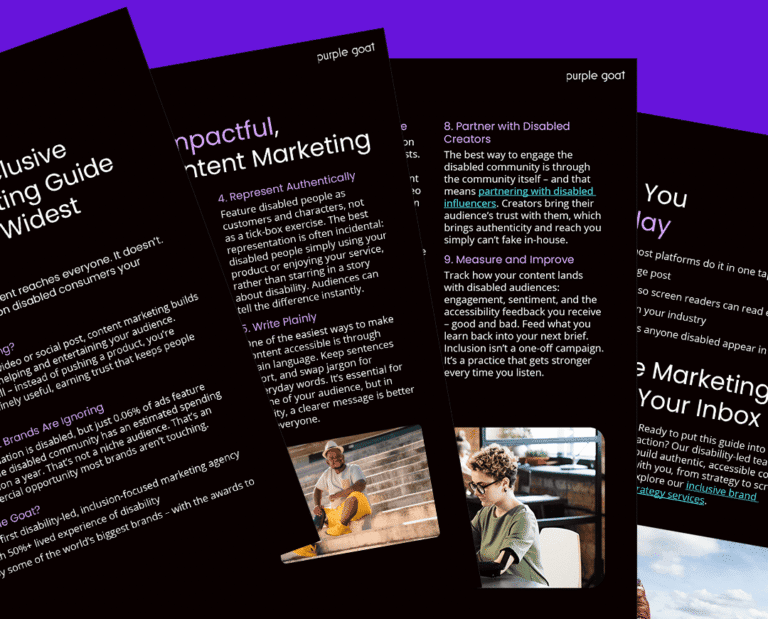
The Ultimate Inclusive Content Marketing Guide: Download Now
Learn how to create content that reaches your widest audience yet.

The fashion industry is severely lacking when it comes to inclusion. And even though there has been a lot of progress in the last decade, there is still a lot of work to do.
From barriers to get into the industry, to lack of authentic representation in campaigns and fashion shows. However, there is something that fashion brands are ignoring that could change this for the better…
A few months ago we met Laura Winson, Co-Founder and Director of ZBD, the inclusive talent agency changing the industry, and we talked about the current state of the fashion world, the reasons why brands don’t create truly inclusive campaigns and how to change that, and the power and advantage that disability inclusion can give fashion brands.
It was a really insightful conversation, and if it makes you want to learn more about how your own brand can become more inclusive, you can check out our inclusive marketing services or contact us today!
[Transcript below]
Trailer (00:00)
Laura Winson:
It was very, very hard. Then, people couldn’t actually even understand the concept of a disabled model. It hadn’t even crossed their minds, which was really shocking for us.
Carmen de Castro:
A lot of the times when people think about inclusion and they think about, oh, there’s an inclusive campaign, usually there’s like, first they look at race and ethnicity, then they look at body types and body sizes, and it seems like disability is something that people cannot comprehend. It’s actually everything is together.
Laura Winson:
We’re not just talking about disabled consumers. We’re also talking about why so many people appreciate and feel a connection to brands that are inclusive. The newer generation, Gen Z, of course, they really appreciate the inclusive advertising regardless as to whether they have a disability or not.
It isn’t hard. Speak to the community, do your market research, get it right, and then you won’t be called as tokenistic.
Intro / Episode (00:54)
Carmen de Castro:
Hello everyone and welcome to The Purple Goat Podcast. I’m Carmen, and today I’m joined by the amazing Laura Winson, CEO of Zebedee (now ZBD), which you’ve probably heard of. They’ve got a documentary on Channel 4 and you’ve probably seen their talent and seen them around on social media a lot. But I’m very excited to have a conversation with you today.
Laura, if you’d like to start just by introducing yourself a bit, your background.
Laura Winson:
Yeah, thanks so much for having me today. Lovely to be working with you guys. Yeah, so I am Co-Founder and Director at Zebedee. How did we get to starting Zebedee? So Zebedee was launched with myself and my sister-in-law, Zoe. and I went to see Zoe one day and we were just having a chat about the lack of representation in fashion in media and advertising. And this was back in 2017, and it is not very long ago, but 2017 it was so rare to see anybody with a disability represented in the media and we were kind of just putting the walls to writes and kind of saying how rubbish it was.
And just for a bit of background, I’m a social worker by background. I was working with people who were experiencing first episode psychosis, Zoe’s performing arts teacher, working with people with learning disabilities. So we both knew a lot of people with disabilities and we were talking about those people in particular and how they just didn’t have, there wasn’t access to an agency or any opportunities.
And so we kind of had a little bit of a light bulb moment. It was really, if nobody else is out there working as an agent to try and find opportunities for disabled people, then why don’t we give it a go? At that point, we’re on the beach, so we actually didn’t even know if anybody else was out there doing that or what the environment looked like. We got back Googled it, Googled how to set up your own business and basically just started from there.
And we just knew from as soon as we had that conversation that we needed to do something about it, and we knew it was a really good idea and we were just going to go full power and go for it. I was on maternity leave, so when my baby was sleeping, I had a bit of time to work on it. Zoe was working part-time. We were both quite lucky that our husbands are both working, so we knew that the mortgage would get paid if we focused, and I know a lot of people don’t have that luxury, so we were quite lucky in that respect and that’s how we started.
And then it’s just gone from strength to strength and we are where we are now. Booking lots and lots of jobs every year and working with loads and loads of brands.
Carmen de Castro:
Yeah, it’s going great for you guys. How has it been the journey since 2017 to now? Obviously we’ve seen a lot of improvement in terms of inclusion, but how has it been from your perspective, seeing it from the inside?
Laura Winson:
Well, like I was saying in 2017, it was so rare to see anyone with a disability represented. Even TV, the soaps, you just didn’t see it at all. And when we first launched, I think we didn’t have a Rolodex of contacts. We had never worked in fashion or media, so we kind of had to learn everything from scratch and work out who to contact. And we literally were ringing Marks and Spencer’s customer service and asked to be put through to the model booker.
We were just trying every avenue we could, and I think it was very, very hard then people couldn’t actually even understand the concept of a disabled model. It hadn’t even crossed their minds, which was really shocking for us. So it was really, really hard and we just had to keep knocking on doors and educating, informing, encouraging.
And I’d like to say now that things are completely different and it’s a whole different landscape and everybody’s been inclusive, but it just absolutely isn’t the case still. And we still are knocking on doors, encouraging, advocating, persuading, doing everything we can to try and get people to understand the benefits of working with disabled people, and the ethics and the values behind it, and just trying to do what we can to make the landscape improve.
Carmen de Castro:
Yeah, there are a few things now based on that that I want to ask you, but from the documentary, which I loved by the way.
Laura Winson:
Oh, thank you.
Carmen de Castro:
I’ll ask you about the actual documentary later, but there was someone from a brand in the documentary that was talking about how the industry is actually very, very early stages of inclusion. Do you agree with that? Do you think brands are still a bit not sure how to approach inclusion and the benefits of it?
Laura Winson:
Yeah, a hundred percent. Of course there’s some brands and some agencies who are doing it better than others. I think the thing is so many people, they really do understand that it’s the right thing to do. They understand that they should be doing it, but there’s just barriers along the way and there are so many barriers. It can come down to being uncomfortable about language, being worried about being called out as tokenistic, these sort of business concerns, are we going to make money from this?
The fear is I think people like to stick to what they’ve done for such a long time, and then they have the fear about doing anything different. I don’t accept those reasons as excuses, but this is kind of what I’m thinking is what is going on through people’s minds. But then I think there is just still the case that there is discrimination out there. People don’t want to sometimes and it really is a really hard conversation to have with people.
And of course they’ll never say to us, no, I don’t want to, I am not going to do it. There’s various things that people will say, but there is this barrier and we have to work really hard to try and educate people about it.
There is a huge business case, of course there is a huge human rights and ethics case. There’s a creative case, there’s amazing campaigns and amazing work that can be done with disabled people and we just have to keep educating, as you guys do, as many people.
Something that has changed I think, is that there are many more people. When we first launched, there wasn’t many other people shouting from the rooftops about this, but now I can see that many people, there is a voice now, a community voice.
And many people, maybe it’s social media, many people talking about this and advocating for it, and businesses even advocating for inclusion. So things are improving, but a hundred percent they’re not where they need to be.
Carmen de Castro:
Not at all.
But yeah, I do think social media has played a big role. Obviously you have such a variety of people that you can log in and see on Instagram and TikTok, et cetera, and even when I was a kid, I would see the size zero type of models, and there’s been that change since then.
But I think a lot of the times when people think about inclusion and they think about, oh, there’s an inclusive campaign, usually there’s first they look at race and ethnicity, then they look at body types and body sizes, and it seems like disability is something people cannot comprehend as it is actually everything is together.
How’s your view from the industry? Do you see that usually from brands? They try to be inclusive, but they don’t push to actually be truly inclusive?
Laura Winson:
Yeah, again, a hundred percent agree with that. You sound like me. I would definitely be saying that. I think, yeah, unfortunately when we first launched we would receive briefs looking for diversity. It would be very clear diversity is key. We want diverse talent. So we’d be like, great, they’re looking for diverse talent, let’s send our talent over. And then they’d come back saying, why have you sent us these talent? We haven’t asked for disabled people. And it’s like, well, you’ve asked for diversity, so this is diversity.
But I mean, I don’t know exactly what the stats are, but even behind the scenes, not even in front of the camera, but in companies, so many companies don’t include disability in their DEI policies. It is like we’ve always said, it’s the last thing that people think about when they’re thinking about diversity. I honestly believe that is changing.
I just talked about before the conversations that so many people seem to be having. I think people understand that inclusion and access are really, really important in terms of the diversity and inclusion landscape, and that is filtering into media and advertising. But yeah, definitely disability isn’t considered where it should be.
And also we need to think about intersectionality as well because disabled people, that’s not their only characteristic. If you are looking for true diversity, then we can think about ethnically diverse people. We can talk about body shape, body size, age, religion, gender and disability. There are so many intersections in society that can be represented in a campaign.
Carmen de Castro:
Yeah, a hundred percent. And going back to when you were talking about the business case, how is it because it’s something that obviously we talk a lot about and we talk with clients about it. Can you talk a bit about from your perspective, the business case of inclusion and disability inclusion and how have you seen it with brands that you’ve worked on?
Laura Winson:
Yeah, I mean we always talk about the business case with our clients. So we probably, many of your listeners will know about the Purple Pound. So the spending power of disabled people is absolutely huge. I think $1.3 trillion worldwide every year. We are not just talking about disabled consumers, we’re also talking about why does society so many people appreciate and feel a connection to brands that are inclusive.
The newer generation, gen Z, of course, they really appreciate the inclusive advertising regardless as to whether they have a disability or not. Most people are impacted by disability, whether it’s themselves as they all get older, they will probably acquire a disability along the way. Most people I speak to will have a family member or close friend with a disability.
So what we try to see is that marketing, including a disabled person, isn’t just reaching the disabled community. It’s reaching everybody who appreciates inclusion and everybody who has links to that community. And so a huge business case, there’s other things like perfection fatigue. We’ve seen it for many, many years, like these airbrushed perfect models and the response to that now is just kind of fatigue and bored of this. This isn’t doing anything to me. This is not me.
How do I relate to that talent, that model. And then there’s also active rebellion. These airbrushed images, we see them, that is not me. I am not going to buy from that brand, that is not representative. There’s so many stats out there to kind of push for the business case.
Carmen de Castro:
Yeah, exactly. But yeah, I think a lot of the time there seems to be that lack of education and lack of information of the actual business case, but even of the actual community and community size. Sometimes when we share stats on our socials and things like that, and we talk about how the disabled community is the largest minority in the world and people are like, no, that can’t be true. I know, yes, it’s 24% of the UK population and you go to, like you were saying, the Purple Pound or the representation on TV ads of disabled people and actual authentic representation. So I think it’s a lot of keep shouting about it and keep talking about it, which I think that’s what we both doing, what we’re both doing.
But yeah, hopefully, I mean I am seeing that changing, potentially positive change. And like you said, I think now Gen Z becoming consumers, I think they’re a lot more aware thankfully because of social media and they express their opinions and they’d be like, yeah, I’m not going to support this brand because I’m not seeing myself represented, I don’t see the world around me here.
In terms of specific brands that you are a big fan of, or brands that you think are doing a great job at creating inclusive campaigns or catering to all types of people, do you have any favourites there?
Laura Winson:
Yeah, well, in terms of fashion, I think Primark have done a fantastic job. So Primark look to have inclusion running through not just their campaigns, not just in front of camera, but also they love to work with disabled creatives as well. And they are really looking at their internal policies and procedures to ensure that they are being inclusive and they continue to use talent as incidental casting.
So if you go to any store, you will see in store, you will see talent with disabilities or on their website you will see disabled people. So I think they’ve done a really great job. Zalando work really, really well with the disabled community. They’ve got adaptive ranges. Their marketing is usually very, very inclusive. I think if you look at the tech brands, of course, in terms of accessibility of their actual products, they’re moving things forward really, really well. And then they’re often the Apples and the Samsungs of the world, their advertising is inclusive.
So there’s many great brands out there that are doing it well. But we know we kind of touched on it, but when we first launched the stats were the representation of people within advertising was thought to be around 00.96% and now the stats are, depending on where you look and who did the study, but maybe between 1% and 4%, somewhere in there. So obviously there’s been a huge increase in the representation. So many really, really increased since 2017 when we first started. Yet you just mentioned 24% of the population has a disability, so 1% is quite low.
So there’s a huge disconnect between the reality and where brands are. And I think even the brands that are doing it very, very well still aren’t at the point of really great authentic and regular representation. So we’re still going to have to keep fighting to get to that point.
Carmen de Castro:
I think this also sometimes it’s not about trying to reach that perfection, but at least trying to do better. And I think listening to the community and understanding what your consumers want, because if brands actually listen to what their consumers want, they probably realise that they need to be changing the way they do certain things, whether that’s in terms of representation, inclusion, accessibility, and I feel like there’s that big issue and disconnect where they’re making the choices without actually talking to the consumers and the people that are actually going to use the products and services.
In terms of campaigns that you have worked on at Zebedee, do you have favourite ones?
Laura Winson:
Well, I always look back to the Gucci beauty campaign because that was really a turning point for us as an agency, and that was with Ellie Goldstein. So she did a Gucci Beauty campaign. Well, at the time it was an editorial and we didn’t really know kind of how it was going to turn out. You never know with editorials where it’s going to go or what’s going to happen, but that campaign went absolutely viral.
Gucci put it on their Instagram, it remains Gucci’s most liked Instagram post ever, near enough a million likes. And for me, I’m kind of like, if that doesn’t prove that consumers are ready for this. Yeah, I don’t know how much, what else I need to do because a million likes isn’t nothing.
So that’s been a brilliant one. And this isn’t fashion, but when, because I had babies when I first started the agency at that time, I just thought, well, we’ll never see babies on nappy packaging with a disability. It just seemed unachievable. But we do. We have babies with disabilities on nappies, we have them on baby wipes. And for me to see from, it just means so much to people who maybe have had a baby with a disability to feel like it’s such less of a lonely place to feel included. It just was really great for me to see that.
Carmen de Castro:
And I think we see that those videos sometimes go viral. I remember when, I think it was the Little Mermaid when the film, the live action came out and it came out that I think her name is Haley Bailey. The actress was playing Ariel.
Laura Winson:
I know My Little Mermaid.
Carmen de Castro:
And there were thousands and thousands of videos of little girls and kids being like, oh, she looks like me. And everyone was loving it. And it was like, it’s there. You can see what representation can do. And that’s obviously a tiny example, but just people are aware of it and know that it’s good. But sometimes it’s that next step where people fail.
Laura Winson:
Disney do a great job actually at inclusion. We had one of our talent, Noah, as one of the Lost Boys in the new Peter Pan movie, and he’s got Down syndrome and I will put my money on it that he is the best actor in it. His casting was absolutely perfect and he did an absolutely brilliant job.
Sorry, Jude Law, Noah was way better. And I think that’s just fantastic to see one of the last boys have Down syndrome. What an amazing thing, how far we’ve progressed to have that. We also, in the film Luca, sorry, I do have kids, so I do know all the Disney. I do know all the Disney film. One of our talent, Kayla talked about this, but she’s got a limb difference and there’s a character in Luca who has a limb difference. It’s not part of the story, it’s just part of who he is. And I just thought that was a brilliant example of kind of incidental casting. Well, it wasn’t it was an animation, but incidental character portrayal that was absolutely brilliant.
Carmen de Castro:
And I think we are starting to see a bit more of that where disabled characters are not just a disabled character, they’re just a character that they’re a great actor and happen to be chosen and that’s it. I think something like Sex Education have done a great job at incidental representation. We’ve talked about it in the podcast before, but I love it and I think they’ve done a great job with a few different characters whether that is gender, disability, I think it’s great and it’s a great example of just how to do it in an authentic way.
Laura Winson:
Well, I think this is a conversation around a client’s fear of tokenism, isn’t it? Am I being tokenistic? But I always say if a disabled person uses that product, then why not be advertising that product? That isn’t tokenistic, that’s just incidental, that is just part of the world that we live in.
And it really irritates me the excuse about tokenism, oh, I’m concerned about being tokenistic. It’s like, well, you have to start somewhere. You have to start working with diverse communities or else you’re being completely exclusive, which in my mind is worse than the fear. It’s not even that you will be called that as tokenistic. The fear of being called out as tokenistic and just speak to it isn’t hard. Speak to the community, do your market research, get it right, and then you won’t be called out as tokenistic.
Carmen de Castro:
Yeah, we talk about that all the time.
Laura Winson:
But we love at Zebedee, we love incidental casting because the way that we work is we put our guys forward for every single brief that they fit the brief for, regardless of disability. And we did that originally out of, we had to because there weren’t any roles being written for disabled people, so we couldn’t just sit around and wait for these roles to come through. They weren’t going to, so we had to, and we felt like that’s equality. They need to be able to access these opportunities. So we’ll always put our guys forward for every single role that they fit the brief for say more often than not when you see our talent, it is incidental casting, which we love.
Carmen de Castro:
Yeah. I want to talk about your documentary. How was the experience, how was the kind of the perceptions that people got after it from your perspective? Are you happy with what people got from it? How was the whole thing? I feel like I was thinking when I was watching it, I was like, how did it feel to be doing your everyday job and then the camera just in front of you following you around?
Laura Winson:
So it was really, really fun, but it also was really, really bizarre as well, I think. Yeah, because clearly there were cameras on it. They weren’t with us all the time. We had days where we knew that they were going to be coming up to see us. I think they filmed probably about a thousand hours more than they required from us when you see how much the team were in the documentary. But it was really, really fun process.
The talent who were involved in it really, really enjoyed it. I think they were really pleased to be involved. And I think the main thing that’s come from it is that people has opened up conversations around representation and hopefully people will continue to have those representations at those conversations. It’s a talking point, and I think the talent came across brilliantly. They’re all really great people and hopefully we didn’t come across too badly either.
Carmen de Castro:
But it was interesting also to see kind of like the ups and downs of the industry. It’s a hard industry. The fashion industry is very hard, and being a model, I mean I assume is pretty hard. So I quite enjoy seeing that. And also I loved how everyone was so just confident. I was like, I’m going to take over the wall, and I enjoy that a lot.
Laura Winson:
Well, most of the people, it’s really interesting actually, because many of the people that apply that might have acquired a disability, they’ve said that, well, Dan for example, who was in the documentary, he said acquiring his disability was one of the best things that’s ever happened to him because it’s opened so many doors. He was in tricky place with his mental health and it helps him through his mental health struggles and having the opportunity to work as a model, as talent and all the people that he’s met and all the opportunities that he’s had. He thinks it’s the best thing that’s ever happened to him.
Carmen de Castro:
I mean, obviously within the disabled community there’s a lot of nuance and people have different relationships with their disabilities. Like you said, some people acquire it later on, some people are born with it, so that’s all they know. But yeah, I think that was interesting to see. And obviously you have different type of talent, so you not just have disabled people.
Laura Winson:
Yeah. So when we launched, clearly our focus was disability, but then we started to get applications from people who had visible differences. So maybe people who have scarring, alopecia, vitiligo, albinism. And we felt because everything we did was about inclusion and allowing for opportunities, we felt really uncomfortable saying that you don’t fit what we do. So we made the decision to be inclusive in terms of visible difference.
And then the same was said for gender as well, for the trans and non-binary community. Again, we started to receive applications from that community, and it just really made sense for us to try and advocate for that community as well. And as I talked about intersectionality, we have people who fit into all three of those characteristics.
So yeah, we’re really proud and something that we’re really proud of as well. Of course, this is our focus, but we take all areas of diversity really seriously. We want to have really diverse books of varying different ethnicities, backgrounds, sizes, heights, and we are really proud. If you look on our website, everyone is so many diverse faces. Whereas if you go look at maybe a typical agency, everyone is very, very, there’s the industry standards aren’t there. So everyone is very, very similar, but we just take those industry standards and throw them in the pin.
Carmen de Castro:
What are kind of the plans that you have for the near future that you can talk about?
Laura Winson:
What are our plans for the near future? I don’t know, continue what we’re doing. I’ve always said I will not stop until representation is where it needs to be. So I’m going to keep going. We’re always going to keep going, but I want to see representation continue to improve to get closer to that 20, 24% of the population. I want representation in media to look like that.
We have a creatives division as well, so we want to see more people with disabilities involved in the creative process, whether it’d be at the point of writing the campaigns or on set once they’re producing the campaigns. So that’s a really important part of where we want to be.
We want to continue fighting as hard as we can to get representation at the fashion weeks around the world to look more inclusive. It’s very, very hard, but we’ll continue to do that, and we never know what we’re going to get in day out, day in, day out. So we’ll keep offering the best service we can to the clients that we get through the door and keep educating along the way.
Carmen de Castro:
Yeah, you’re doing a great job.
Laura Winson:
Thank you very much.
Carmen de Castro:
In terms of the actual fashion industry, what are your ideal future of whether fashion industry is going to get to or how does an inclusive fashion industry look like?
Laura Winson:
So there’s many areas to talk about here because it’s not just, obviously our focus is in front of the camera and it’s the representation in front of camera. Clearly fashion is not where it needs to be. The high street’s doing much better than luxury. So I’d love to see luxury getting it and moving forward with representation.
We do speak to many luxury brands and they are doing what they can in terms of their recruitment and their policies to be more inclusive in their organisation, but it’s not necessarily filtering through to in front of camera. So there is something that needs, we’ll have to continue working with luxury to see if we can get there. Yeah, I’d love to see that happen.
I’d love for people to think about how to represent maybe some of the less visible disabilities. Think about creative ways to do that. Perhaps it means there’s going to be more of a focus on socials and creators who are able to talk about their stories and their relationship to disability as well as working with brands and moving forward in that way. I just love to see things improve in terms of representation.
Carmen de Castro:
Hopefully they will.
Laura Winson:
Yeah.
But yeah, they’re still a long way to go, but also we need to look at where we were and where we are now. And progress has been made.
Carmen de Castro:
Slow progress.
Laura Winson:
No, it’s huge. It is slow progress, but actually it’s huge. If you look at 0.06% in 2017, and between 1 and 4, I don’t know the maths, but that’s loads and loads more percentages than what it was.
Carmen de Castro:
Kind of like, to wrap it up, I wanted to ask you about models and any advice that you have or any aspiring models who think the industry is not for them who have a disability or just maybe don’t see themselves represented in fashion campaigns or comparing themselves to all the models, they just don’t see they fit in.
Laura Winson:
Well, I think taking it broader than that, I think anybody should consider this. There’s many people who we’ve scouted or who’ve kind of fell into it rather than thinking that this is something that they want to do. So first of all, consider it, and if you are thinking about it, then get in touch. Go into our website at Zebedee and just have a little look.
So one of the main things to think about is it isn’t all as the documentary show, it’s not all showed, it’s not all kind of glamour. It can be hard work, it’s very last minute. It’s very fast paced. Do you have the family and support around you to kind of ensure that this can be a successful career for you, whether it’s emotionally or in terms of practical things?
Unfortunately, it’s very, very London centric or globally. It’s like you need to be in one of those big hubs like New York, LA, London, or able to travel quite easily. There’s so many restrictions just to society, to not make this easy for disabled people. So it’s kind of like do what you can, work with who you can to kind of make this work for you.
I think it’s really important to work on perhaps get acting lessons or feel confidence, your ability to take direction, feel confident in front of camera, do shoots with editorial shoots or test shoots to build your confidence, get a really nice portfolio, but just to continue with your aspirations. You can do it, you can achieve it if you want to achieve it, and absolutely get in touch and we’ll try and help you along the way.
Carmen de Castro:
Nice. Is there anything else that you’d like to mention?
Laura Winson:
I don’t think so. I think really, really thank you for having me here today and for all the work that you guys are doing. I think we wouldn’t be where we are today without organisations like yourselves doing the work that you are doing.
Just a call out to all brands, like you have to start doing this. You have to start being inclusive. You have to take that first step, and it isn’t that difficult. You might have concerns and fears around it, but it isn’t difficult. You can meet the needs of your disabled talent and we will hold your hand to do that. So yeah, just do it.
Carmen de Castro:
Yes. Sometimes that fear kind of stops people from doing it and just saying, don’t worry. You don’t have to be perfect. You don’t have to know everything.
Laura Winson:
Exactly.
Carmen de Castro:
It’s a process and just being open to that, it’s a great first step.
Laura Winson:
Yeah. We are constantly still learning. We love being allies, but we need to learn more every day. Disability is so diverse and there’s so much to learn. Even tech, modern tech, there’s so much tech out there that we need to learn about. Yeah, there’s just so much that you can learn, but we’re all in this together so we can all learn together and hold each other’s hands along the way.
Carmen de Castro:
Yes. Well, thank you so much, Laura. It’s been great.
Thanks everyone for listening, watching wherever you’ve listening or watching to this, and thanks to iD Studios, which you may recognise the background already, great space. We love you guys and yeah, thanks so much for watching and we’ll see you very soon.