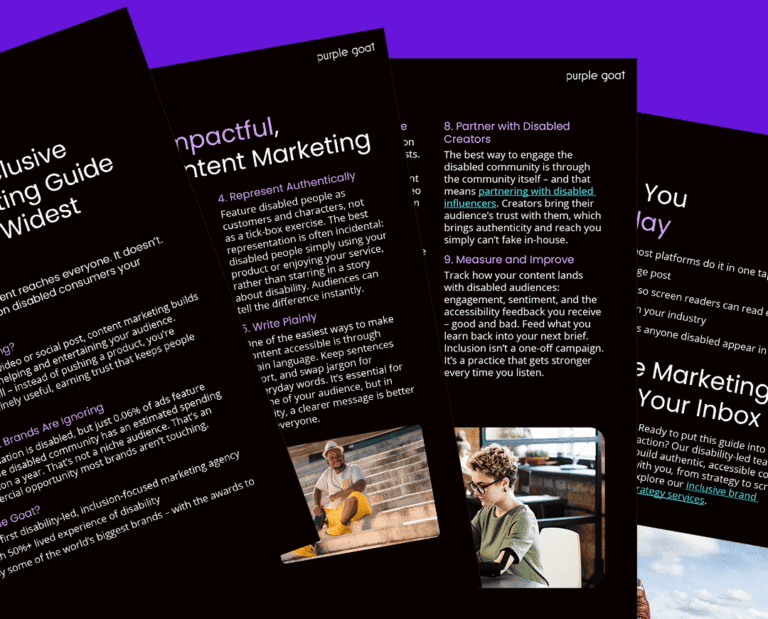
The Ultimate Inclusive Content Marketing Guide: Download Now
Learn how to create content that reaches your widest audience yet.


In today’s crowded, hyper-competitive market, brand positioning is essential for any company. Customers are overwhelmed with choice, but you can do something today to make sure your brand is at the top of their minds.
The benefits of brand positioning are endless. Once you do it effectively, your audience will understand you, learn how they feel about you, and most importantly if you’re into numbers, why they should choose you over other competitors. And when inclusion is baked into that positioning, brands don’t just stand out, they build long-term growth.
In this article, we will explore why brand positioning matters, how it differs from branding, and how inclusive positioning unlocks meaningful business impact. Let’s begin!
Imagine there are ten brands offering the same product that you really need, but you’ve only seen and resonated with one of them. You will probably be choosing that one.
Once you’re on the brand side of this situation and realise this, you’ll learn that brand positioning is the foundation of every successful marketing strategy. It shapes perception, informs decision-making, and defines how your brand shows up in the world.
At its core, positioning answers one critical question: Why should someone choose your brand? Without a clear answer, even the most beautiful branding or creative campaigns will struggle to make an impact.
Your positioning tells customers your values, your expertise, and your understanding of their needs.
Strong positioning tells your audience:
For B2B brands especially, positioning is closely tied to trust and authority. A well-defined positioning strategy ensures that every touchpoint, from messaging to tone of voice and thought leadership, reinforces your role in the industry. This is why brand positioning sits at the heart of any effective B2B (or B2C) growth strategy, and you can learn more about it in our B2B Brand Strategy.
There’s nothing new about us talking about the power of inclusion in marketing, but when it comes to brand positioning your brand can really be missing out. Today’s consumers expect brands to reflect the diversity of the world around them, and they reward those that do.
Inclusivity in brand positioning means:
Research continues to show that inclusive brands outperform others. A study from Oxford University found that inclusive advertising drives higher sales, stronger brand value, and 15% higher customer loyalty. I am sure you want that for your brand too.
You can also check out our article on the power of inclusive marketing on businesses to learn more about this.

Branding and positioning are often used interchangeably, but they serve slightly different purposes. Brands that understand the distinction will use their resources more effectively.
Branding is the overall image of your business. It includes:
Branding shapes how your business looks and feels.
Positioning, by contrast, is more focused and strategic, and it’s defined by the relationship with your customers. It builds a place in the market and in the mind of your audience in comparison to your competitors.
Positioning clarifies:
While branding is the “how”, and the “face”, positioning is the “why” and the “heart”.
The most successful brands align branding and positioning seamlessly. When the two work together:
In inclusive marketing, alignment is especially important. Visuals, language, and experiences must reflect inclusive positioning authentically, not as an afterthought.
Strong brand positioning delivers measurable and long-lasting value for companies. Below are seven key benefits of brand positioning that inclusive brands experience.
You want your audience to get your brand, to understand its personality, its products and its ideal customer, and see themselves represented in them. Clear positioning will help achieve that, as it ensures that marketing teams, agencies, and stakeholders are aligned on messaging and purpose.
This consistency will in turn build trust and recognition over time.
In saturated markets, differentiation is everything. Strategic positioning highlights what makes your brand unique.
Inclusive positioning often elevates perceived value by showing cultural awareness and social credibility.
Brands that connect emotionally outperform those that rely solely on rational benefits. Inclusive positioning allows audiences to see themselves reflected, respected, and understood.
That emotional resonance leads to deeper engagement.
When people feel seen by a brand, they stay. Clear positioning creates loyalty because it reinforces shared values and consistent experiences across every touchpoint.
This is particularly powerful for inclusive brands that prioritise accessibility and representation.
Strong positioning doesn’t just retain customers, it attracts new ones! Brands that clearly articulate who they’re for (and why) gain a competitive edge and an advantage over other brands in the market.
Positioned brands are easier to remember. Over time, consistent positioning builds mental availability, making your brand the first that comes to mind when a need arises.
Paradoxically, strong positioning allows for more flexibility. When your brand’s core purpose and audience are clear, adapting messaging or offers becomes easier, without losing authenticity.

Inclusive positioning amplifies the benefits mentioned above while delivering additional strategic advantages that impact both customer experience and business outcomes.
Inclusive marketing is the GOAT, what can we say.
When accessibility and diversity are considered from the beginning, products, services, and platforms become easier to use for everyone.
Better UX leads to higher conversion rates and stronger customer satisfaction.
Authentic inclusion strengthens brand reputation. Consumers are increasingly sceptical of performative marketing, and they expect brands to demonstrate their values through action.
A positive brand image comes from consistency between what you say and what you do, something that you can explore in more depth in our guide to Authentically Inclusive Marketing.
Inclusive positioning opens brands up to wider audiences, including the Disabled community and other minority groups that are often overlooked.
This will, in turn, give inclusive brands stronger financial results. If you want to learn more about the power of inclusive marketing, make sure to check out our article on the ROI of Diversity and Inclusion, showing that inclusion is not just “the right thing to do”, it’s commercially smart.
The benefits of brand positioning are clear, but real impact comes from doing it right. That means grounding your positioning in insight, strategy, and inclusion from the very beginning.
Purple Goat is an inclusive marketing strategy agency that helps businesses build positioning and campaigns that resonates with people and drives measurable growth. From defining your market role to embedding inclusive thinking into every brand decision, Purple Goat ensures your positioning is both purposeful and profitable.
If you’re ready to strengthen your brand, connect with broader audiences, and build long-term value, explore our inclusive brand strategy services below:
Inclusive positioning isn’t a trend, it’s the future of brand success.