The Ultimate Inclusive Content Marketing Guide: Download Now
Learn how to create content that reaches your widest audience yet.
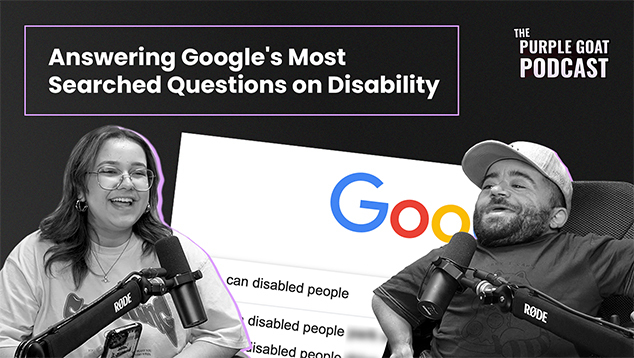
We know you have lots of questions on disability, so hopefully this episode will answer most of them.
As a disability-led agency, we want our clients to feel comfortable around inclusion and disability, so we’re open books and try to educate through our lived experiences.
HOWEVER, it’s important to remember that disabled people don’t exist to answer all your questions, and they don’t owe you an explanation of their medical history. So always be mindful of how you ask your questions, and maybe find creators and advocates online that are doing a great job at educating and raising awareness on disability.
Us, at Purple Goat, work with brands to make them feel confident around all things disability, and help them create truly authentic and representative marketing campaigns, so if you’re a brand looking to be more inclusive, look no further!
But without further ado, let’s dive into today’s episode.
[Transcript below]
Trailer (00:00):
Amanda Codea:
Today we’re going to be answering some of Google’s most searched questions around disability.
Dom Hyams:
Well, I might not be the right person to answer all these questions.
Amanda Codea:
What can disabled people do? What do disabled people do all day?
Dom Hyams:
I’m just like a really boring dude.
Amanda Codea:
This one’s going to be fun. Where do disabled people go to jail?
Dom Hyams:
I don’t actually know the answer to this. Officially.
Amanda Codea:
What do disabled people struggle with the most?
Dom Hyams:
That’s a really interesting one.
Amanda Codea:
How do disabled people have kids?
Dom Hyams:
That’s a spicy one.
Introduction (00:38):
Amanda Codea:
Hello and welcome back to The Purple Goat podcast. I was so good last time that they brought me back on today.
Dom Hyams:
True story.
Amanda Codea:
Today we’re going to be answering some of Google’s most searched questions around disability, and I’m going to be joined by Dom.
Dom Hyams:
Hello.
Amanda Codea:
Welcome back, Dom. I feel like you’re always here.
Dom Hyams:
Sorry, I’m always on this side as well, so people probably think it’s all the same podcast, but I can assure you it isn’t.
Amanda Codea:
Firstly, can you please explain to me a little bit more about your disability, your kind of lived experience, so we can verify that you’re the right person to answer these most searched questions?
Dom Hyams:
Well, I might not be the right person to answer all these questions however, so I’m Dom. I was born with brittle bones, or if you’re feeling fancy, otherwise known as osteogenesis imperfecta. I’ll let you spell that later, which basically means I’m of short stature. My bones break easily.
I had 24 fractures when I was born. I’ve used a powered wheelchair all my life ever, since two years old. And in my kind of life and career, I moved into sort of focusing in and around doing things in the realm of disability and progressing the narrative around disability representation for the last 15 years or so. So hopefully I can answer some of your questions for you.
Amanda Codea:
He’s got a good CV.
Dom Hyams:
I don’t think I actually have a CV at the moment, which is probably a bad thing.
Amanda Codea:
So I think the first section of this is like myths, misconceptions, but the first question is what can disabled people do?
Dom Hyams:
I feel like there’s probably going to be the same kind of answer on a lot of these questions, and, I mean, they’re going to be hilarious I’m sure. But what can disabled people do? So obviously, as disabled people, the word essentially refers to the fact that there’s some intrinsic barrier that stops you, as an individual, from being able to do those that others might be able to do.
Obviously, that normally refers to a physicality. So something that you can’t do due to some condition or impairment. The reality is though, that the world around us has been created in such a way that there are those that are put on us by society, whether that be institutional, environmental, whatever it may be. And so in reality, disabled people can do so, so much, but often it’s the things around us that stop us from doing those things.
As a teenager, I didn’t really experience many barriers on me as an individual, and therefore my connection with my identity as a disabled person wasn’t very strong, I suppose because I just wasn’t disabled by my life. I was totally comfortable in my own skin, in who I was, my condition, but at the same time, I was doing all the things I wanted.
My mates, my parents encouraged me more than even I was kind of open to doing. They kind of pushed me to do all sorts of weird and wonderful and wacky things, and that meant that there wasn’t really anything I couldn’t do. So I think that we have this view that disability and someone’s physicality is what’s stopping them from being able to achieve certain things, but so often it’s the things outside of that that have concocted that perception.
Amanda Codea:
Nice. What a solid answer.
What do disabled people do all day?
Dom Hyams:
Embarrassingly, if I told you what I do all day, it won’t be evident of what most disabled people all day, because I just watch boring YouTube videos about coffee shops, aviation, travel..
Amanda Codea:
F1.
Dom Hyams:
..technology, I watch way too much Formula One. So I’m just a really boring dude.
But disabled people as a whole do all the things that you, other boring people in your YouTube vortex, also do. We have the same desires, the same wants, the same needs. Disabled people are just people that happen to live utterly normal lives. That sometimes really surprises people.
But like anyone else, I love travel, I love food. I love going out with mates. I love doing normal things, but I also like pushing the boundary of what I can do as well, and try and do things that maybe I wouldn’t have, 20 years ago, thought possible or whatever as well. So I suppose that, yeah, all the normal stuff, but then also make sure as an individual I’m living for the day and living for the moment and trying not to sort of wish my days away.
Amanda Codea:
Yeah, be intentional.
Dom Hyams:
Intentional.
Amanda Codea:
Look at you.
Dom Hyams:
I think we talked about this the other day. There was a quote from, oh God, I’m going to butcher this. It was Jimmy Carr on another podcast. We can reference it somewhere. He was saying almost everyone would give everything they have in 25 years time to be where they are 25 years before in terms of health, age, whatever.
You would essentially, if you could, turn that time and do it all again, you would get everything you had. And that’s such a powerful metaphor for just actually how precious are those 25 years or whatever, many years. And I suppose that as an individual, I feel like I live that breathe out in how I approach life. I try and take every opportunity and make the most of it in that way.
Amanda Codea:
Yeah, it’s really, yeah, it’s a great perspective to have and generally as well, not living as if anything is transitional and just being in it.
Nice. You’re going to like this one.
Dom Hyams:
I’ll like this one.
Amanda Codea:
What do disabled people do for fun?
Dom Hyams:
Retweet on the last one. No, so disabled people do all sorts of the same things that everyone else does for fun. They also don’t just stay in a bubble of disabled people. They are just, shock horror, integrated into society as everyone else’s, and enjoy all the same things that anyone else might enjoy in their life. So whether that be going out to restaurants, going on holidays, being with friends, shopping, I don’t like shopping, but shopping. I don’t go shopping for shoes. I don’t like, I hate shopping, actually.
That’s probably the one thing I don’t do. But yeah, everything that “normal people” do, apologies for the quote marks, disabled people are doing them too. And it is staggering to think that some people don’t understand that.
Obviously there are certain individuals in the community that do more of one thing or less of one thing because of what they can and can’t do, and what they want to do. But again, it’s like everyone has free will and free choice to explore the world around them in the way that works for them.
Amanda Codea:
As they should. So, next question. What do disabled people struggle with the most?
Dom Hyams:
That’s a really interesting one. I would say disabled people struggle most with the institutional barriers that mean that a lot of things in life just don’t happen in the same way and with the same level of opportunity that others might.
So the workplace is a really obvious one. We don’t see the same representation of disabled people in the workplace. So we know that there are intrinsic barriers. Maybe moving house if you needed accessibility in your home, actually getting the support and provision you need to have something adapted can be very difficult. It also means that people maybe struggle to go from one locality to another very easily. I’ve called it kind of ‘glass walls’ rather than glass ceiling thing, where actually you want to go from A to B, but because of all the logistics involved in that, it becomes inherently quite difficult and people feel essentially trapped.
And then you might have interactions into the public environment. The public perception of disability is still something that not everyone is totally comfortable with and we’re a very polite race. So the thing that I often find I’d say maybe affects me more than anything is if I know I’m making someone uncomfortable, I find that quite a hard experience. I’m so comfortable in my own skin and I don’t literally, I don’t think about myself and my physicality as anything negative or anything like that ever. But then when I’m in having an interaction and I can feel myself having to appease someone that is feeling uncomfortable themselves, that’s an interesting interaction.
And that happens all the time. And it’s not necessarily from a place of malice, but it’s from a place of ignorance. And so I think that the fact that we still have a lot of that and a lot of people don’t know how to interact in and around disability, that creates natural barriers there for disabled people in society.
I mean, I’m not going to say that there aren’t a load of things because there are, and of course as an individual I’m always going to, in some ways, put a positive spin on certain things, it’s just kind of my nature. But there are other difficulties there, and that ultimately is why in some shape or form, like at Purple Goat, us representing the disabled community to the world in all shapes, sizes, guises, backgrounds, ethnicities, intersectionalities, that’s so powerful because it educates people on all the different lived experiences and all the barriers that the whole community are facing on any given day.
Amanda Codea:
Yeah, great.
Yeah, this is going to be an interesting one for you. Where do disabled people sit on a plane?
Dom Hyams:
Not in the baggage, if that was the implication? Yeah, the implication.
So on a plane, the wheelchairs at the moment, shout out to people like Rights On Flights that are trying to change the perception of where people sit with their wheelchairs on planes, but at the moment the wheelchair goes underneath the plane. Then you have this dance where, for someone like me, I will get transferred into an aisle chair and then brought down the aisle of the plane and then, to be honest, sit anywhere.
Although sometimes you get this interaction where they don’t want you to be a fire hazard on the aisle seat, so they make you go to the window, even though that’s more complicated. But then they don’t want to say, we’re putting you by the window because you’re less likely to make the others burn in hell.
So they don’t like to say that bit, but that’s what they really mean is they’re less likely to burn if you are by the window and they’re going to get out quicker than you are. So let’s do that. So I suppose the only real answer is more often near a window, but essentially anywhere you buy. So obviously not usually right at the front unless you’re balling it
Amanda Codea:
Fair. Are you balling it?
Dom Hyams:
No, but if anyone wants to send me on first class flights, I will take them.
Amanda Codea:
Heard it here first.
Where can disabled people work?
Dom Hyams:
Disabled people can work in every environment that anyone else can work in, aside from the physical limitations that would stop me being a fireman, for example.
The reality is there is so much opportunity for disabled people to be more embedded into our working structures and organisations and businesses and brands. And we know that there is that lack of diversity in the organisations that exist out there. And that is something fundamentally that we, as an organisation, want to see change. But as a community, we definitely want to see change as well.
As soon as people crack the idea that actually having the widest diversity of people in any given organisation gives you the best kind of outputs, and that’s been understood and known for so long, if we can actually practise what we preach and make sure that that happens, we’ll just start removing some of these intrinsic barriers that exist so quickly and so easily.
And so for me, it’s really about making people realise that yes, we might have to put in some adjustment, like a workplace adjustment for someone, or we might need to educate someone or whatever else it might be. Or we might need to make sure someone feels comfortable by using some wording on an advert for a job or whatever it might be. They can be such small things, but ultimately the world of opportunity of what the disabled community can contribute is so big and so wide, and we are currently doing a pretty shoddy job of actually making that happen.
Amanda Codea:
Yeah, I think one of the things I kind of really hit home for me at working at PG is that like you’re saying, is the only barriers there really are to disabled people being able to do all the things that they want to do or can do, and all these things, is the barriers that are put in place by non-disabled people, just institutions or just that systemic kind of barrier, as opposed to it being something intrinsic with disabled people that make them be unable to do things.
Dom Hyams:
A really simple example of that is, so I used to work in TV production and pretty much on the first day, I think one of the first days that I was in this company, I went to Royal Ascot for a live broadcast. It was Royal Ascot, and I went and got put in a OB truck and broadcast sort of track with all the feeds and all the directors and producers, everyone there. But I had to be lifted out my chair up some stairs and put in the truck.
And that instantly, that day I knew I wasn’t going to be a live TV director or a producer because the equipment is not designed in a way that I was able to actually utilise it. So it wasn’t going to be practical for me in later life that I would always rely on someone to lift me under a truck.
They do exist, there are accessible trucks, but it’s not the norm, but it’s why aren’t these spaces in the same way that if we design a building, we make sure it’s got accessibility nowadays, something like a broadcast truck, absolutely that can have the same provision put into it.
Similarly, the actual gear in that space, are we making sure that things can do live captions for those that actually work in that environment, or are we only expecting those that don’t need live captions to use that equipment? It’s those kind of considerations as well. Not just the physical spaces, but the technology that we’re interacting with in our working environment that also essentially there’s a duty there to start implementing more natural accessibility and inclusivity into everything that people interact with.
Amanda Codea:
Yeah, a hundred percent. Because at the end of the day, it just makes it better for everyone, even having, for example, an accessible truck where if it does lift you, it could be used to lift equipment, other people.
Dom Hyams:
Exactly. Inclusive design.
Amanda Codea:
This one’s going to be fun. Where do disabled people go to jail?
Dom Hyams:
We’ve actually talked about this quite recently, didn’t we?
Amanda Codea:
Yeah.
Dom Hyams:
I don’t actually know the answer to this officially, officially. All I can assume is that if I got convicted of the heinous crime, I’d have to go somewhere that is more akin to a glorified hotel because I’d need a lot of support. So I just assume that I’ll be in some kind of high security care facility where I reckon, just guessing, that the coffee’s going to be better there than it would be in jail.
So I don’t actually know. But the reality is I couldn’t exist in a normal jail. I don’t think. I’ve been through a dinner in a jail once. The Clink restaurant where they create, so they’ve created a training programme for chefs in the prison, and then they train them in the skills. So then when they come out of prison, something like 90% more employment opportunities and 10 times less re-offending because these people have got distinct skills that they’ve been trained in, and then they can go straight into a job.
Amanda Codea:
That’s amazing.
Dom Hyams:
Yeah, and the meal was great, but it was very unusual being in the prison for the meal. I think it was Brixton prison, but yeah, that was an experience, but not one that I’d like to be back on the other side.
Amanda Codea:
Yeah, absolutely.
Dom Hyams:
If that makes sense. No plans.
Amanda Codea:
A hundred percent.
Dom Hyams:
No plans just yet.
Amanda Codea:
Yeah. Have you seen there’s comparisons of a uni hall and then a prison cell, and then sometimes the uni hall will be worse than a prison cell?
Dom Hyams:
I can believe that. Yeah, I can definitely believe that.
Amanda Codea:
Okay. How do disabled people drive?
Dom Hyams:
Yeah, cool question.
So the reality is there are so many different ways that disabled people can drive. Often even the individuals themselves might not know that there is provision out there for how they are able to drive themselves.
So I have had a Motability vehicle since 2005, 2006, something like that. And it’s honestly, the day before I passed my test, I was the most nervous. I don’t really get nervous about that many things in my life. I was so nervous. I didn’t really sleep the night before because I just knew the power of the independence that passing my driving in test would give me as an individual. And the car I learned on was the car that was provided by Motability, and I had to wait for that car to arrive and be ready before I could learn because my hand controls are so special.
So I don’t know whether you can sort of see this, but I’ve got an accelerator and a break in my left hand, it’s the other way to what you think in your head it would be, it’s not accelerate break, it’s the other way around because if you hit something, you don’t want to accelerate into it. So forward is break.
And then on the top of that I’ve got a button that cycles around different functions and you press it a different amount of times. So wipers, lights, that kind of thing. And then in the right hand I’ve got steering, and then I’ve got two kind of display things. One does the sort of gears, it’s an automatic, but drive, park, all of that jazz. And then over there the functions that you don’t need every day, but it’s really, really cool. And even though, so I’m now on my second vehicle, probably about to go for my third, even though the technology right now is probably similar to that that I had 20 years ago.
I drive from the chair as well. So I go up the lift to the back through the car, and then my seat becomes the seat of the car, if that makes sense. And even though I’ve had that same kind of technology the last 20 years, people are still absolutely mesmerised by seeing me drive. I’ve had people on motorways just drive past me, and then I see them slow down because they want another look. And that’s a really common thing because they just see me and they’re probably like, oh my God, he’s driving.
But it is absolutely amazing what’s possible. My controls, yes, they’re quite a lot there, but actually there’s also all sorts of other controls, people that can control a car just from certain muscles on their face to their head, and it’s quite incredible the technology that is out there. So all I can say is if you feel that driving might be for you, and you’d want to explore what’s possible, then do you speak to Motability and see if that’s an option for you. Similarly, if you’re not eligible for Motability, then do talk to adaptation companies and see what just the remit of possibility might be for you as an individual. It is awesome.
Amanda Codea:
Hashtag not an ad or sponsored.
Dom Hyams:
Hashtag not an ad.
Amanda Codea:
Just a genuine user.
Dom Hyams:
But as a disclaimer, we have worked with Motability in the past.
Amanda Codea:
Yeah, look at us hitting all the right things.
Actually, another question I have on driving, could you have another wheelchair user as a passenger in your car?
Dom Hyams:
Technically, yes, but they would have to have the same locking system that I have at the bottom of my chair. So there’s a mechanism underneath my chair where if I drive my wheelchair over the locking system, it clamps in automatically and then I press a button and then that releases the car. So technically if the car did a somersault, my chair would stay in the car.
Amanda Codea:
Okay, that makes sense.
Dom Hyams:
I’m not sure whether I would, but the chair would.
Amanda Codea:
How do disabled people exercise?
Dom Hyams:
Not enough. No, genuinely. Again, disabled people absolutely can exercise, do exercise, should exercise. I definitely used to exercise a hell of a lot more than I do now. You might not believe it, but when I was 11 years old, I shuffled a mile on my bum for charity, two hours. And every lunchtime at school before that, I would do about half a mile in training for a couple of months.
Amanda Codea:
That’s so cool. Did you not get friction burns?
Dom Hyams:
I broke my femur.
Amanda Codea:
Oh, that’s a big bone to break.
Dom Hyams:
I didn’t know at the time, but it affected my femur doing it. And that almost started the chain of events where, I mean, we’re not going to do a sort of anatomy show here, but I’ve got giant knees and it meant that shuffling as I got older, essentially my bones deformed and they go in weird, wonderful places over time.
But my knees have got to a size where actually even shuffling on my bum became more difficult. And so that I was sort of whizzing around on my bum everywhere until I was about 15 years old. And then just naturally as I sort of gained more independence and went to university and things like that, spent more time in a wheelchair. So 14-year-old Dom and 13-year-old Dom literally just lived on the floor. And if you went into my room, you’d probably have got vertigo because everything’s low down. You feel like you’re in the Borrowers or something.
But that’s how I lived my life. And then I only transferred into my chair when I wanted to leave the house. So that’s definitely changed as such. That has meant that I as an individual, don’t exercise as much as I used to for sure.
I love to swim when I literally am bothered to make the time for it. Literally, I’ve had the conversation this week about going swimming more with Sophie. I’ve used to do a lot of weights as well, so I do quite a lot of hand weights. But saying all of that, Dani, to Dani, she’s a qualified PT, I genuinely am like, I want Dani to give me a regime, put me through my paces, and then we’ll see this miraculous transformation into someone that resembles Mr. Olympia in a matter of weeks.
Amanda Codea:
Yeah, we’ll send Dani this clip.
Dom Hyams:
The only serious point I’ll make is, from my experience, like gyms and things like that, historically have not been particularly inclusive places.
I know that you probably talked about this in your kind of chat with Dani before, but I’ve been to gyms and been like, “oh, hey, can I just have a swimming membership?” And there’s such a ‘computer says no’ moment of like, no, we don’t do that. We just do the full.
And you’re like, well, I don’t really want to spend the tens and tens and tens of pounds a month on this full gym membership with this and this and this, when actually I’m literally going to use the pool, which if you broke it down, would be much less. And so that lack of flexibility there for actually catering to what individuals want and need can be frustrating.
The one thing I will say is over time, the conversation has got better around including disabled people in the conversation. So in the way that we see more disabled creators represented in campaigns from sort of sportswear brands, that’s really important. People want to be able to be seen in these environments.
Obviously we’ve got the Paralympics and things like that, that can show that for disabled people sport is equally as important as it is to everyone else. It’s just for any individual, they’re going to just have their way of making sure that they’re partaking in sport and exercise. And we all know the value of doing that. So of course it’s important, and it’s just hopefully down to these companies to help us make that happen.
Amanda Codea:
And if you need our help, you know where we are.
Next one is how do disabled people feel?
Dom Hyams:
I mean, honestly, it’s a great one because the reality is that we have had this perception, and we talked about it on an earlier vlog, we’ve had this perception that disabled people are intrinsically sad, and they are to be pitied, and life is not good. Of course, as we’ve spoken about, there are barriers, there are things to work through. There are difficulties that those without disabilities are not facing and are not going to diminish any of those.
But at the same time, it’s sometimes incomparable to people that disabled people’s lives can be positive, can be enjoyable, can be fun. And dare I say it, I wouldn’t change who I was for the world. And some people really almost struggle with that because they’re like, “what? That doesn’t align with what I’ve seen in the media”.
So I think that we, again, like at Purple Goat, what we are trying to do all day every day is show the rounded view of disability and the nuance that’s part of that. You can be disabled and have an incredibly enjoyable forward-thinking, positive life. And yes, you’ll take the difficulties with the awesome moments, but doesn’t everyone do that in different guises? So I think that it’s just important for us to realise, but more than anything, we’re all human. And that’s first and foremost. And then the disability bit for most people is just a secondary part of the conversation.
Amanda Codea:
Last one on this section is how do disabled people have kids?
Dom Hyams:
That’s a spicy one. That’s good.
Amanda Codea:
Finishing on a high.
Dom Hyams:
Yeah. So disabled people can be parents too. Obviously, to have kids, the birds and the bees has to happen. Firstly, that’s very possible for a lot of disabled people. And again, it’s amazing how fascinated people in the general public are about the mechanics of how disabled people have sex. And you’re like a) why would you be that interested? Depending on who it is, in the same way that you wouldn’t ask someone what their preference is or whatever.
You know what I mean? So that side of things is kind of almost a side question. And if you know someone really well on the best bait, of course you wouldn’t even ask. I don’t even know. But at the same time, the reality is to say, well, people have the same wants, desires, as I said before, than anyone else.
There’s people with that maternal instinct that want to become parents, and do become parents. There’s people that just want to get out there and date a lot and do all of that stuff. And also that’s awesome. There can be considerations around certain disabilities when it comes to genetics and things like that. And of course, everyone has the choice to do what they want when it comes to family planning and whatever.
So again, there’s kind of intrinsic barriers in place for certain people around it, and that’s just something for them to kind of work through. But it doesn’t mean that that is not something that’s possible. Again, it’s just about knowing all the options of what’s out there and then working out what is right for you as an individual, that kind of thing.
Like family planning is just such a personal thing for all of us, whether you’re disabled or not, that actually we just need to respect the choices of individuals and how they go about that process. But the same wants, needs, desires exist in all of us, and that is also perfectly possible for almost all of us as well.
So yeah, it’s amazing how little that is talked about though, because it’s almost like some people can’t compute the combination of disability and sex in a conversation and they’re like, whoa, no, that’s like overload of progressive tonality. But the reality is that it’s happening all day every day. Wherever you are in the world, we are all human.
Amanda Codea:
There you go. I think that’s been the main takeaway, without putting words in your mouth about asking you to summarise, but we are just all human and there are very many ways to do different things, and it’s just about finding those different avenues. Just because your way of doing something might look a little bit different to the way I might have to do something doesn’t mean that it’s not right or it shouldn’t be happening or any of those things.
Dom Hyams:
Amen.
Amanda Codea:
Amen.
Okay, so last question for us to wrap up is what are the, aside from all of these, what are some of the most common misconceptions and stereotypes about disability that you’ve encountered? and how can we go about debunking and challenging them, but then how do you personally go about them?
Dom Hyams:
I almost like, I’m not that good at remembering all the misconceptions that you deal with on a day-to-day basis. One that we haven’t covered is that I’ve got a sort of infantile perspective of the world because a) I’m small, but b) I’m disabled.
I will get people come up to me and talk to me as if I’m a child. And again, it is from a place of ignorance, but it’s one where I thoroughly enjoy the interaction, 99% of the time. I enjoy the interaction of seeing someone have their world spun around a little bit when I essentially challenge their misconceptions around disability.
And you could see it, it’s a thing, and it’s really powerful when you are able to do that. So maybe I’m kind of just a bit sick. And I deal with that bit of it. But it is true that most of the time we all have certain bad days or days that you don’t want to do certain things. And in the same way, not every day has to be a day that you are a teacher of disability to other people. It’s absolutely fine if you don’t want to be that.
But at the same time, those little moments can be quite powerful where you are teaching someone about a misconception or a preconception that they might have of you as an individual. I think it goes into all sorts of things. Like they’ll assume that Sophie, my partner, is a carer. That’s really, really common.
They’ll assume that I am not going to work. So if I’m on a train going somewhere, they’re going “anywhere nice today?” and it’s 8:30 in the morning on a Tuesday, I wouldn’t normally choose to be on a train at 8:30 on a Tuesday unless I was actually going to work. That kind of thing. I mean, obviously it’s an untold amount all day, every day.
There are certain interactions where you know that you are having this moment where you are challenging someone’s preconception of what disability is. But similarly, I know how I live and experience disability is different to other people. So I don’t want to say that everyone should not think, well, everyone should think that my experience is the norm because again, I know it isn’t. I have certain privileges. I know that I’m lucky in so many ways around who I am and what I do. And so I don’t want for one second, want people to not think that the wider world out there experiences it in other ways as well.
Amanda Codea:
Yeah. Okay. I lied. It’s not the last one. So looking ahead, what do you hope to achieve in terms of great acceptance, accessibility, and inclusions for everyone with disabilities?
Dom Hyams:
More than anything, and we touched on it earlier, I would like to create a world where everyone is incredibly comfortable around all aspects of disability, and everyone is treated equitably. Everyone is given the opportunity to thrive.
But in that kind of way of framing it in around comfort, I think that if we can make those we interact with comfortable and educated and give them insight, if we can make the organisations that exist in this world understand the needs of different communities, if everyone’s going to have this baseline knowledge, then the reality of making an inclusive world becomes incredibly straightforward in some ways.
I know that that’s a huge sweeping statement, but the reality is if you had the community in every space and place and group and everywhere in society, you just naturally have the people there that can help shape to make it sure it’s accessible, because they’re the people that you are helping shape it for.
And that sounds like a really obvious, but yet over simplified reality. But it’s true in the same way that we just have men and women equally in society, as equally as we’ve got to and is still work to be done, of course. But that’s not even a consideration now in our minds and well for anyone that we would care to talk to.
But the reality is disability can go that same way where everyone has the same comfort around all people and they’re not thinking, “oh I’m talking to a woman now, I’m not talking to a man”. That concept is crazy. But that’s where it kind of probably was however many centuries ago. And so that’s kind of ultimately where I’d love to go, what we do at PG, helping shape that comfort, confidence, empowerment in those that we talk to and that we talk with.
Outro (37:43):
Amanda Codea:
And on that note, it’s been great to chat with you and debunk all of Google’s most searched questions and find out that disabled people do indeed feel, have fun, have children, fly..
Dom Hyams:
And have embarrassing YouTube search histories.
Amanda Codea:
As all of us do, I’m sure.
And yeah, also thank you to ID Studios for having us and for having us in their space that is incredibly inclusive and accessible. And yeah, thank you so much to you for watching and listening.
Dom Hyams:
Thank you, have a great day.