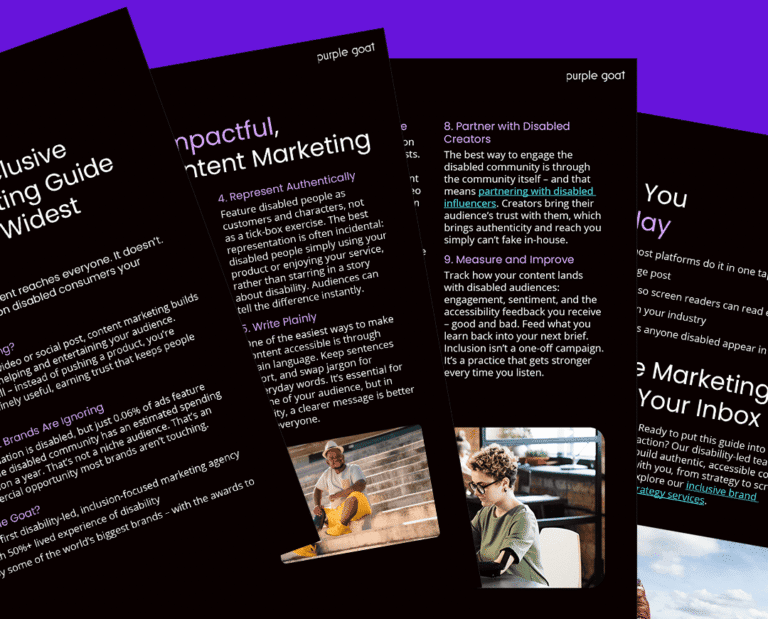
The Ultimate Inclusive Content Marketing Guide: Download Now
Learn how to create content that reaches your widest audience yet.
Disability representation and diversity are two closely related terms that promote inclusivity. In this blog, we will take a look at the differences, similarities and challenges faced, as well as highlight real-life examples of successful marketing campaigns. Let’s get into it!
To put it simply, Diversity is a broader term that refers to a wide range of human differences, including race, gender, sexuality, age, religion, and socioeconomic status, as well as disability. Diversity is about recognising, respecting, and valuing these differences in society.
When we’re talking about diversity representation, we’re referring to an authentic portrayal of society in different environments, whether that is in a movie cast, an organisation, or a marketing campaign. The world is formed by a diverse group of people and everyone deserves to see themselves represented everywhere.
In workplaces, schools, media and politics a broader perspective can increase levels of creativity, problem solving and innovation, as well as increase levels of empathy and understanding between people from different walks of life. Some people may think that diversity is about being politically correct, but diversity truly is about creating an environment where everyone feels included, respected and empowered!
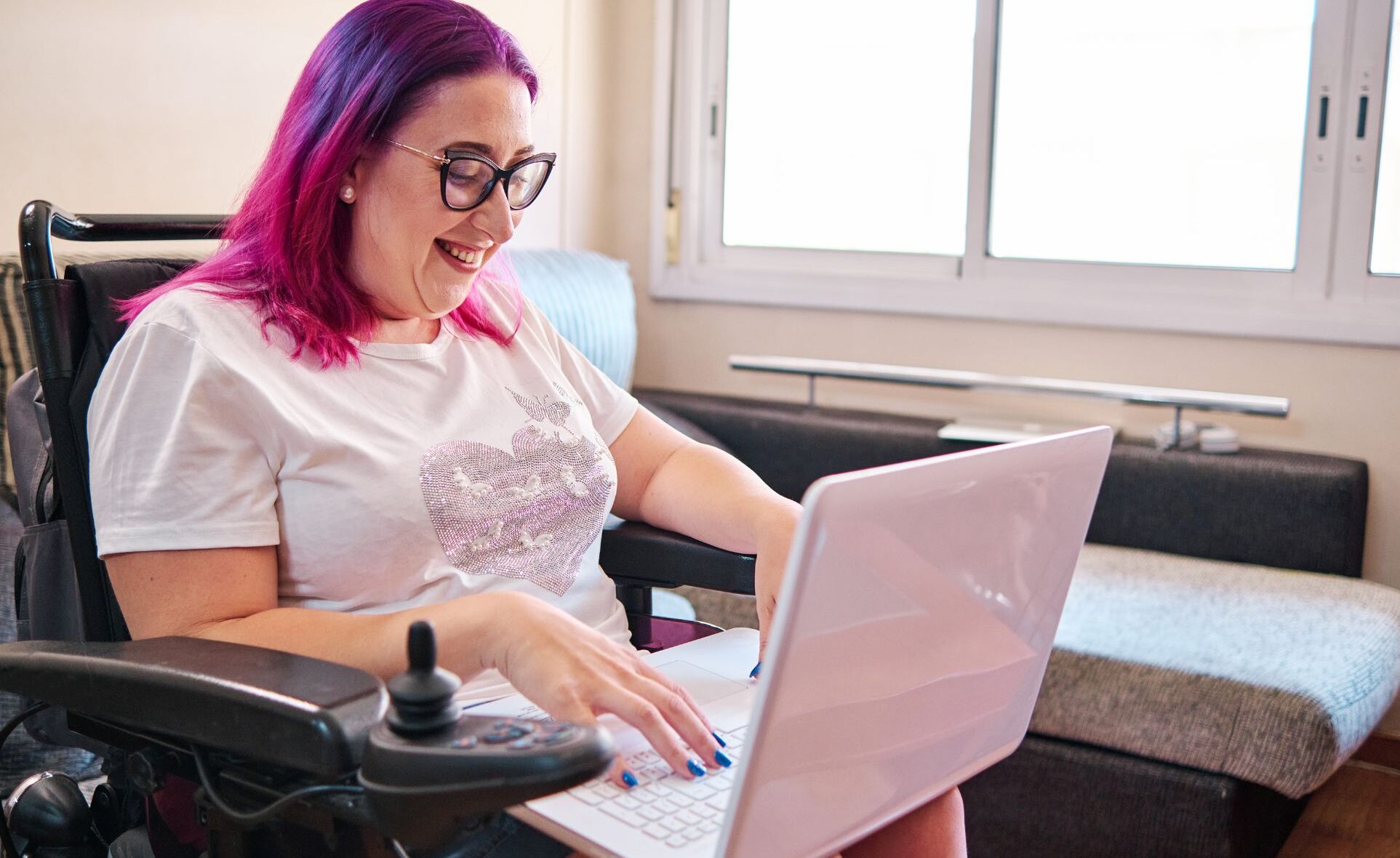
If we’re talking more specifically, disability representation involves accurately portraying people with disabilities in all facets of life – in media, marketing, literature, politics, education and employment. It highlights the importance of considering accessibility, understanding disability as a part of human diversity, and ensuring that people with disabilities have equal opportunities and rights.
For both types of representation, it’s important to remember that it’s more than just presence; it’s about portraying disabled and diverse individuals in a manner that is respectful, realistic, and devoid of stereotypes. It involves recognising unique challenges, while also celebrating people’s contributions, strengths, and resilience. Through this, we challenge misconceptions and foster a more inclusive and understanding society, where differences are not just acknowledged, but valued.
Too often we talk about diversity and leave disability out of the conversation. But the truth is that diversity cannot exist without disability.
As we’ve already pointed out in this article, the world that we live in is incredibly diverse, and there are several minorities with protected characteristics, one of them being the Disabled community. But did you know that this group of people is actually the largest minority in the world? It makes sense to think that they should be included when thinking about diversity.
Whilst disability representation and diversity are two separate terms, there are some similarities. These include the promotion of inclusivity, challenging stereotypes, raising levels of education and awareness, advocating for equal opportunities, creating accessible environments to all, and highlighting the importance of fair representation in society.
However, both terms may also face similar challenges, which include:
In this ad, Pantene features Lucy Edwards, who shares her experience of being Blind and ‘seeing through touch.’ Lucy shares what her hair feels like and how she knows what it looks like ‘through that annoying sound.’ Lucy also uses the phrase ‘great hair is not how it looks to the world, it is how it feels to me.’
This subtle, yet powerful script, successfully markets the product whilst authentically sharing Lucy’s experience of being blind. This demonstrates how those who are visually impaired or blind can use this product and feel empowered. Pantene then takes it a step further and uploads accessibility instructions in the video description, including how to activate audio descriptions and closed captioning.
This advert by London North Eastern Railway features a wide variety of people of all ages, gender and ethnic backgrounds. LNER weave many narratives into this advert and successfully, yet subtly celebrate the diversity of people.
For this short film, Vanish took authentic voices and experiences to another level, following the day in the life of a girl called Ash, who has been diagnosed with Autism (played by an Autistic actress!). The video educates people about the needs of people with Autism, such as Ash telling her teacher that she needs her ‘overlay’ to be able to read a document.
However, it also beautifully highlights her skills and strengths, such as her mathematic abilities in the scene where her friend asks, ‘how did you do that without a calculator?!’ The advert also weaves in friends, teachers and pupils from various ethnic backgrounds, which touches on diversity. The addition of high-pitched ringing noises alongside fading background noise adds a further layer of what sensory overwhelm might feel like, enabling people to empathise and understand Ash’s day-to-day experiences.
Even though challenges exist when it comes to both diversity and disability, companies must do their part in helping change society and create a more inclusive and accessible world for everyone. A simple way of doing this is through their marketing and communication activities.
Most consumers are digital natives or spend a big part of their lives online, which means it’s a great opportunity for businesses to show their commitment to diversity and disability inclusion through social media content. Below are some things to keep in mind:
This is a marathon, not a speed run. Don’t try to do everything at once and in the quickest possible way, because that won’t give you the results that you want to achieve, and there’s a high likelihood that you will be biased with common stereotypes about those underrepresented groups. Think of it as a journey you can be on, work with those groups and learn to understand your audiences better. This would avoid both stereotypes and tokenism, and will generate the best results for your business.
Representation is a simple way in which you can create more diverse content. Make sure all your social channels and campaigns are representative of your audience.
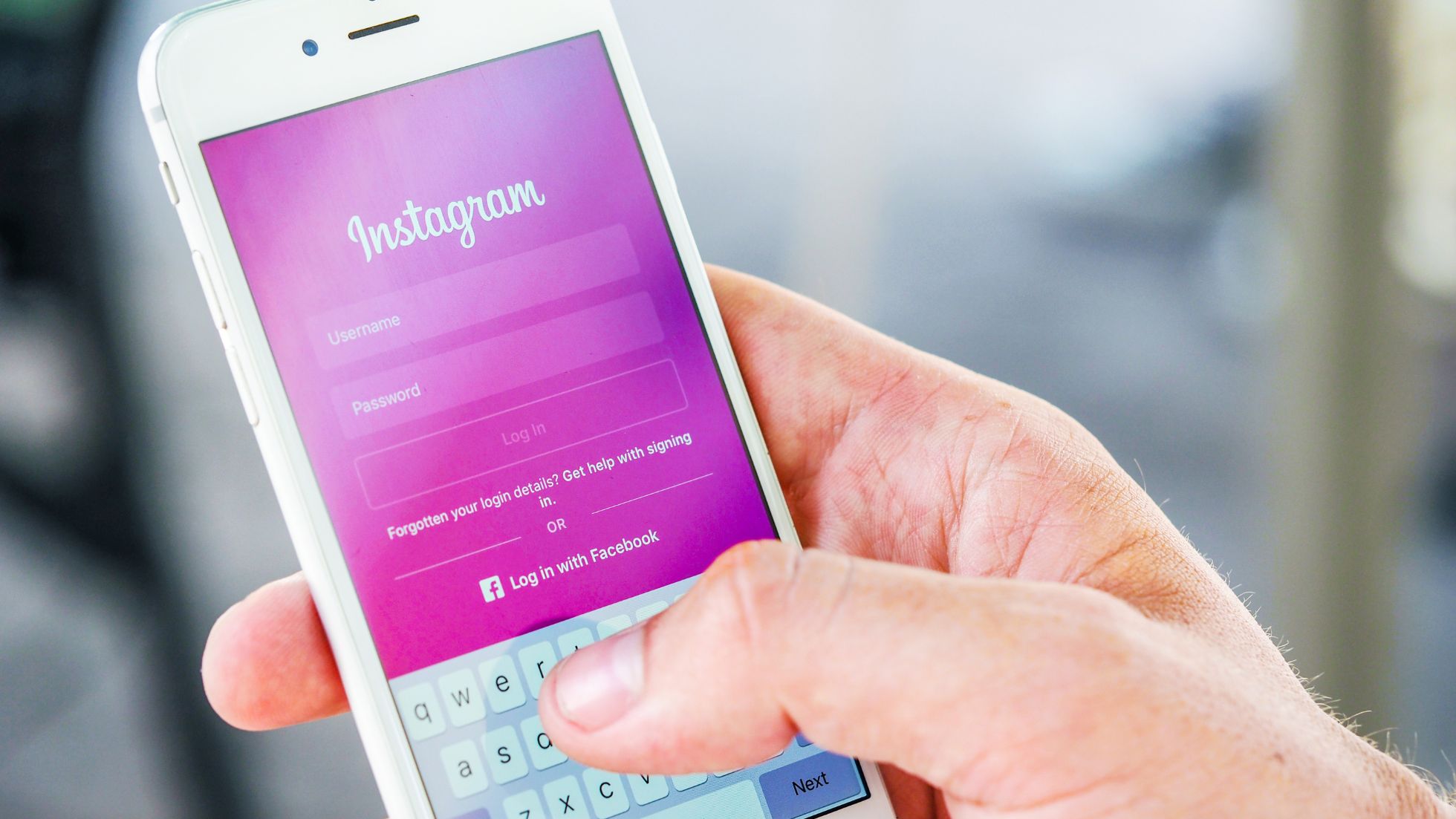
Accessibility is often an afterthought, but if you think about it from the start it will save you lots of time afterwards. Make sure you know how to create accessible content on platforms like TikTok and Instagram, but also look at the bigger picture, can your events, shops and activations be more accessible to everyone?
Diverse teams are the dream teams. Having different lived experiences throughout your business is incredibly important to avoid tokenism and make sure you’re not making decisions about them without them. As we always say, ‘Nothing about us, without us’.
As you can see, both disability and diversity representation provide platforms for authentic voices and experiences to be heard and acknowledged. One of the key takeaways is that all differences should be celebrated, not just accommodated. The narrative is slowly shifting, and we hope that in the future, the first thought that comes to people’s minds can be, ‘Wow, what a unique perspective and asset to our team and society!’ rather than ‘Oh, we need to make adaptations.’
Here at Purple Goat, we specialise in listening to the Disabled community and delivering bespoke qualitative and quantitative research to understand what disabled individuals think and feel about your product, brand or service. We also support organisations to run inclusive paid social campaigns to drive great business results. Get in touch and find out more about how you can authentically represent the world we live in!
No, diversity is not the same as disability. Diversity refers to the broad range of differences among people, including race, ethnicity, gender, age, sexual orientation, religion, socioeconomic background, and more. Disability is one aspect of diversity. Including individuals with disabilities contributes to a more inclusive and representative environment, diversity encompasses much more than just disability, but diversity couldn’t exist without disability.
Diversity refers to the presence of differences within a given setting, including the unique protected characteristics, backgrounds, experiences, and perspectives that individuals bring. It embraces differences in race, gender, age, culture, religion, language, disabilities, and more. In the workplace or society, promoting diversity means valuing and respecting these differences to create a more inclusive and equitable environment.
Diversity includes all the characteristics that make people unique. This can be classified into visible and invisible traits such as race, ethnicity, gender identity, age, disability, sexual orientation, cultural background, religious beliefs, education level, and life experiences. Even differences in thinking styles and communication methods qualify as diversity, making it a multifaceted concept that extends beyond just demographics.