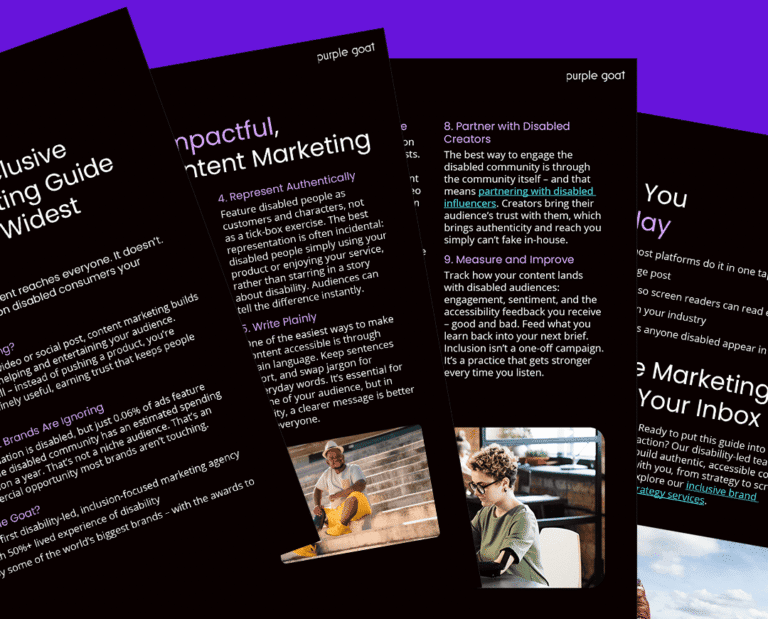
The Ultimate Inclusive Content Marketing Guide: Download Now
Learn how to create content that reaches your widest audience yet.

There are often stereotypes and myths when it comes to disability, and at Purple Goat we’re always working to show the reality of disability and create a progressive narrative around it.
In today’s episode of The Purple Goat Podcast, Carmen sits down with Dani and Dom to discuss their journeys of being Disabled, their thoughts on words like ‘inspirational’ and ‘superpower’, and how brands can achieve an authentic portrayal of disability.
Enjoy!
[Transcript below]
Trailer (00:00)
Carmen de Castro:
Use three words to explain how you think people view disability.
Dom Hyams:
Infantile.
Dani Roberts:
Pitiful.
Dom Hyams:
Sad.
Dani Roberts:
I guess when you start to deal with real life scenarios, like going to university and trying to live independently and learn to drive and gain employment, you start to face more barriers and challenges and then that’s when you actually realise like, oh, okay, I am disabled and I’m experiencing these things because I am disabled.
Dom Hyams:
I don’t think about disability really at all. I’m Dom and I’m not Dom from PG and I’m not disabled Dom. I’m just Dom.
If there were two words we see most in client creative before we’ve given our thoughts and feedback, it’s probably inspirational and superpower.
Dani Roberts:
Yeah. I would personally avoid inspiring and superpower when working with brands.
Intro (01:02)
Carmen de Castro:
Hello and welcome to the Purple Goat Podcast. Today ,I’m with Dani and Dom and we’re going to be talking about how the world views disability versus how it actually is.
We’ll talk about their own self identities as disabled people and how that’s changed throughout their lives, how people view disability, how brands should approach disability. What about the words inspirational and superpower that we see a lot associated with disability? So this and a lot more in today’s episode, and again, we’re at ID studios. So let’s go.
Hello guys.
Dom Hyams:
Good morning.
Carmen de Castro:
Good morning. Today, I have you here to talk about how the world views disability versus how it actually is. So I have some questions for you and I want you to tell me about your own views and your journey of being disabled, if that has changed throughout your life.
Dom Hyams:
The juice.
Carmen de Castro:
The juice. We are here for the juice, right? So to start with, I want you to try and use three words to explain how you think people view disability.
Dom Hyams:
Should we take it in turns one each?
Dani Roberts:
Sure.
Pitiful.
Dom Hyams:
Infantile.
Carmen de Castro:
Nice.
Dani Roberts:
Oh, is it back to me?
Dom Hyams:
Yeah.
Carmen de Castro:
We can do four. So you do two each.
Dani Roberts:
Depressing.
Dom Hyams:
Yeah, depressing is a good one. A close neighbour of depressing is sad.
Carmen de Castro:
Right. Okay, we got the idea. So what words will you now use to explain how it actually is from your opinion?
Dani Roberts:
For me, I’m going to say normal because I don’t know anything different. So it’s just my normal.
Dom Hyams:
Hilarious is the word I’ll use. The reason for that is that I think that I’ve been in a lot of situations in my life that I wouldn’t have otherwise been in if it hadn’t been for the disability that I have.
Dani Roberts:
I think I’m going to say belonging because I think you get a sense of being disabled, you’re a part of the disabled community and belong in a really great group of people that can all relate and understand your experiences and what you go through.
Dom Hyams:
And I would say, I suppose it’s positive, and again, that is something that we don’t necessarily see depicted in our media or in the words that we picked up on at the start, but people really struggle to get their head around it. And you see the sort of cogs turning when you actually say, know what? I personally have an overarchingly positive experience of life. Of course there are difficult moments and barriers, but in different ways everyone has that, and I’m not for one second saying that disabled people don’t have the huge amount of difficulties and barriers at moments, but there is also that positivity that you can hopefully do have in life as a disabled person as well.
Carmen de Castro:
Nice. So after you’ve said those things, would you say your view of disability has changed over time and your self identity as a disabled person? How has that journey been throughout your life?
Dani Roberts:
Yeah, my identity with being disabled has changed massively. I know we’ve spoken about this a lot, Dom. When I was younger I didn’t really identify as being disabled. When someone would ask me about my arm, I’d literally just say, oh, it just doesn’t work right? Or this is how I was born and I would never call myself and say that I was disabled. Just would never happen.
And then I guess, yeah, as I got older and probably more around late teens, early twenties, I guess when you start to deal with real life scenarios, like going to university and trying to live independently and learn to drive and gain employment, you start to face more barriers and challenges. And then that’s when you actually realise, oh okay, I am disabled and I’m experiencing these things because I am disabled too. And there should be ways to, society could be way more inclusive and try and combat those things. But yeah, it’s definitely shifted. And then obviously working at Purple Goat as well, that’s helped shift a lot of the way that I identify with disability too.
Dom Hyams:
Very similar for me really. I think in my younger life, when I was at school, I was very probably, slightly different to Dani in that I was always so acutely comfortable and confident with my disability, but I just had, I would say almost an aversion to hanging out with disabled people and doing things that disabled people do. For no other reason than it just wasn’t part of my world and I had such a rich existence in what I was doing, I just didn’t feel the need to connect with that part of me.
I was so comfortable with my disability, but there weren’t really any barriers on me. I could do anything I wanted to do. My parents encouraged me to do everything I possibly wanted. I went to a mainstream school, had non-disabled friends, I went on holiday. It was just a very, to use Dani’s word, a normal existence. And then exactly the same as Dani. You grow up and you have these moments where you’re like, oh, there are very, very real barriers that mean that I’m experiencing this in a very different way to someone else.
My options and reduced, there are additional hurdles to jump through. I have to fight and advocate for certain things to get parity of experience. And I think that that’s when you naturally just sort of lean more into that community and feel more connected. So yeah, quite similar in that way I suppose.
Carmen de Castro:
And one thing I wanted to ask you, Dom, was you, when you were 18 maybe you did a documentary, was it with Channel 4?
Dom Hyams:
Yep.
Carmen de Castro:
Could you tell us about it?
Dom Hyams:
Yeah, so again, it kind of connects to that point. And so when me and my mates were planning a trip around Europe inter railing after our A Levels, and we knew at the time there was this narrative in the media around it, ASBO culture, every teenager’s a hood Street rap doing terrible things. And I had a, again, normal group of mates that were just really caring, considerate guys, but we were also the same guys that like going out, having a good time and you just didn’t see that in our media.
So we were sort of planning the trip around Europe after A levels and before all going our separate ways to universities. And there was this sort of collective light bulb moment of do you reckon we could get a bit of extra money if we made this into a TV show? A bit beer money?
And I remember very clearly being in Burger King as a group thinking about this, then went home and didn’t realise I was writing a treatment for a TV show, but essentially was telling the production companies in an email, yeah, it’s going to be full of jeopardy because I’m disabled and my mates are great and they throw me around like a piece of luggage, and then sent that off to about 20 production companies and it came back and about four or five were genuinely really interested, which I now find out is extremely unusual and rare for that. There must have just been the perfect storm of what was happening in our society and then what I was presenting must have been a very much of interest in that moment.
And we, to cut, long story short, we went on a trip. It was lovely. It gave me amazing insight into the world of media and marketing. And I probably wouldn’t be here today if it wasn’t for doing that, but when I was 18. But the bit that I know you’re getting to was we called it ‘Crip on a trip’ and that was a name that came about because when I was 16 and went away with friends, we all got t-shirts made going down to Newquay was a rite of passage for our school when you finish your GCSEs, and my t-shirt said ‘Crip on a trip’.
And I genuinely can’t really remember when I came up with that name or whatever, but calling the documentary ‘Crip on a trip’ felt perfect at the time. I couldn’t be further away from the historical negative depiction of “Crip” in that documentary, in my relationship with my mates. And it was me kind of owning and claiming that word to be what I wanted it to be. However, that I was really comfortable with, we put a little caveat out on the Channel 4 website, obviously as you can imagine, Channel 4 loved it as well. It was quite a Channel 4 name.
But nowadays people ask me, oh, would you call it that now? And I say, well, probably not, only for the fact that I now both personally and professionally have grown and am so much more connected to the community and I know that there are certain people that absolutely would be offended by that word and offended by that use of the word. And so I’ve basically just sort of assimilated a lot of the community’s thoughts and feelings into how I project myself. So I think that as 18-year-old Dom, I’m really happy he did that. I wouldn’t change that at all, but if someone asked me to name something today, I wouldn’t probably name that, if that makes sense.
Carmen de Castro:
And Dani, is there any advice or anything that you would tell your younger self?
Dani Roberts:
I don’t think so. I think I wouldn’t really change anything. I definitely had opportunities when I was younger playing football and stuff that I literally had because I was disabled, I played for a disability football team and stuff. I think if anything, actually leaning into the community a little bit earlier would’ve been really great for me.
When I think back, I can’t even remember knowing anyone else that was disabled, but the teacher that I had at school that had the same disability as me, which is super, super rare and I think was just a one in a million kind of event that happened. But except for that, the only other time I saw disabled people was when I was at the hospital having my appointments and stuff. So I just wasn’t really exposed to the community I guess. And I think nowadays with socials and stuff like that, people can find other people who are in very similar situations to themselves and I think that’s super, super powerful.
Carmen de Castro:
Nice. And going to what we do at PG and the mission, obviously we are talking about disability all day every day, but in terms of you outside of work, how does your own advocacy look like? Does it look any different to what you do at work?
Dom Hyams:
Do you want me to go?
Dani Roberts:
Yeah.
Dom Hyams:
I think that people find it quite surprising that outside of work, even though we probably work more hours than we should, there’s not many hours outside of work, that I don’t think about disability really at all. I’m Dom and I’m not Don from PG and I’m not disabled Dom, I’m just Dom.
And I am not going to say that I’m sort of not as aware or not as progressive as I am in work because I still have all the same values. However, I personally just don’t, I’m not really affected by things that we advocate and push for professionally. I don’t care.
And I know that sounds crazy, but someone can say anything to me in a personal capacity and as long as their intention is good, I don’t really mind, obviously I still want to make sure that I’ve got the quality and equity of experience in what I do in life, but I’m also happy to just go with the flow and things just happen because it’s hard to constantly advocate for disability all day, every day in what you do.
And there’s moments where you just want to, I wouldn’t say blend in, but you just want to crack on. And so as much as in the professional capacity we are at the bleeding edge of being as progressive as possible and constantly trying to push those we work with to be at that bleeding edge of progressive tonality and process and everything, on a personal level, you don’t want to fill your brain with that all day, every day. And some people find that really unusual I suppose. I dunno whether that’s the same for you.
Dani Roberts:
Yeah, pretty similar.
I mean, as you said, advocating for disability all day every day can be pretty exhausting, and I just like to switch off when I’m not working and like you said, you’re just Dom. I’m just Dani. I just want to be myself and live my life and not really think about it too much.
I think, yeah, all of our clients are really great. They’re all trying to genuinely make a change for disability and make a space that’s more inclusive. But some of the conversations we have can be really challenging and it is just exhausting as you’ve said. And yeah, it is just nice to have that break and just have a little bit of space where you can just be you and as you said, crack on, just get on with your life and enjoy it and not think too much about the bigger picture all the time.
Dom Hyams:
I would say on that point, we sometimes don’t even realise the sort of natural advocacy, consultancy, handholding that we do all day every day. We are there to change the clients’ we work with perception around disability, but also their actions around disability. So we are constantly, I suppose on, if that makes sense.
We’re constantly trying to challenge their assumptions, challenge their habits, preconceptions, and then ultimately what they do. And it might not feel like it in the moment, but you are just constantly representing PG but constantly representing a progressive view around disability. And that’s quite an unusual thing to have, not even at the back of your head, but it’s sort of deep inside all day every day.
The only other bit I was going to say was the bit outside of work. We’ve got this really progressive professional tonality in work ,outside of work, I’m sure we’d both be cancelled. If you get us just with our families or our mates and the things that we do. Again though, that’s just us being us in our little bubbles. We can say what we want, how we want to who we want, and that’s quite a funny juxtaposition of our professional lives and our personal lives as well.
Carmen de Castro:
Nice. I have two words that I want to see what your thoughts are. One of them is the term inspirational and that associated to disabled people. So how do you feel about it?
Dom Hyams:
I think you’re actually going to get an interest answer from both of us.
Dani Roberts:
Okay. I’m intrigued there.
Dom Hyams:
Personally, I don’t really mind. As in inspirational because I personally find things that I am not used to, haven’t seen before, have been educated by, is the word inspirational? No. Is it insightful? Yes. But it’s a very close step, and so when people say it sometimes they’re like, I know that they don’t mean any harm by it, so it doesn’t offend me again on a personal level, but it isn’t the right choice of word because me just being me shouldn’t necessarily be inspirational. It can be kind of insightful and educational, but I don’t want to be held on a pedestal for just being who I am.
Obviously professionally, we absolutely don’t want this polarised view of disability with triumph over adversity. You are there purely to make non-disabled people feel good about themselves. So on a professional level, absolutely not. But if you are going to say, oh, you’re so inspirational to me in a pub or whatever, I’m like, thanks. And it just doesn’t really have an effect on me, if that makes sense because I get it, but it’s just not how we would view a progressive conversation around that topic, I suppose.
Carmen de Castro:
What about you, Dani?
Dani Roberts:
I think for me. it depends, and it depends on the context. There’s so many people out there who happen to have a disability that are doing genuinely inspiring things. If I am on social and I see someone maybe that I follow that’s doing something really freaking cool, that’s going to inspire me to do something cool to, then absolutely that’s the right use of the words.
If you are just calling someone inspiring because they’ve got a bed, got dressed, gone to work and lived their life, then that’s not really that inspiring. And it’s just like, you are just saying that because you’ve got the assumption that disabled people can’t meant so much or there’s not a lot of expectation there on that person to live a really successful life.
And I guess, yeah, for me it just depends on the context. I think it’s really complicated, obviously, and as a community we tend to try and stay away from it because typically it is used in that environment where the disabled person is just existing and living their life and it’s like, oh, that’s so inspiring. Is it? Do you know what I mean?
I want to be inspired by disabled people. I want disabled people to go and do really incredible things. And then I’m like, oh my God, wow, I want to do that too. Or that’s inspired me to do X, Y, and Z off the back of that. And in that instance, for me it’s totally okay to use that word. It’s not. But again, like Dom said, personally I’m not that bothered, but I think I’m also a little bit desensitised to at this point, it gets thrown around a lot.
Dom Hyams:
The moment it is relatively triggering is when you are literally going about a totally innocuous activity, sat on a train, and so it’s like, good on you man, you’re so inspiring, whatever else. But then you realise the only reason they’re saying that is because they’re like ‘your life being you in that chair looking like you do must be sh*t’. And so that’s why they’re saying inspiring. They’re essentially saying, well, I’ll just go and *** myself if I was you. That’s awful.
And they have no idea that as much as they are trying to convey something positive, all they are doing is showcasing their inner prejudice with that comment. So that’s like the extreme end. And those are the ones you’re like, okay, thanks, yeah. But then as Dani said, there are moments where absolutely anyone in society can inspire us. And so it’s kind of very situationally specific as well.
Dani Roberts:
Yeah, context is key. A hundred percent.
Carmen de Castro:
Nice. And the other term is ‘superpower’ related to disabilities and calling your disability your superpower ,that we see a lot in the media.
Dom Hyams:
I’ll let you go first.
Dani Roberts:
I think it’s a tricky one.
I think for me, my disability, I will never view it as a superpower. It makes my life more challenging and difficult and yeah, there’s not really anything superpowery about it. That’s just how it is. But at the same time, I wouldn’t change not being disabled.
But yeah, I dunno, the term superpower is really interesting. I know that there are quite a lot of people that do use it and kind of see their disability as a superpower. And I think if that’s the way somebody needs to view it and that helps them, then they have to do what feels right to them. For me personally, it’s just never going to be a term that I identify with or something that I would ever use to describe my personal disability. I don’t know, for me, personally, I am not gaining anything from my arm. It’s not giving me some extra skill or doing anything incredible. It doesn’t work, my arm doesn’t work. So there’s nothing superpowery about it.
Dom Hyams:
I think for me, I agree with Dani in the sense of I wouldn’t change who I am. So that’s not part of the conversation in that like, oh, disabilities is made me a better version of me. No, I am very disabled because of my disability. So you can’t say it’s the superpower there.
Of course, I can understand that there are things about my lived experience that have given me a different perspective, outlook, whatever it might be on life because of my disability and that that’s the bit I wouldn’t change. I would say that I’m a relatively perceptive person because my whole life I’ve spent probably observing more than others because I’ve been sitting back watching the world go on around me. And maybe that’s why. Is that a superpower? No. Is it part of who I am? Yes. But so I think that for me, superpower isn’t, again, relevant and I don’t connect with that phrase.
However, for some people, as Dani said, the way that they view the world because of their disability is it feels different to them. And I think that there are certain individuals that their disability means that they do kind of feel that they’re over indexing in certain ways and of course if they want to use that word, that’s absolutely fine.
We wouldn’t professionally say it on someone’s behalf because it’s totally personal and up to them. But if they do, then that’s, we’d obviously encourage that, but people should always be able to own the language around themselves. And however there is this sort of brands ask us, oh, what’s this perfect way of describing all these different things? We often say, look, there’s no perfect playbook of all the language you have to use to all the different situations because it can be so personal.
However, we would always encourage individuals to lean into language that works for them, obviously with a slight caveat of certain words that are very offensive to certain people, so just be mindful of that when using them. But if you’re saying that behind closed doors and it’s the way that you’d like to talk, then how can anyone have any issue with that, I suppose.
Carmen de Castro:
So taking this to the professional side of you too, and at PG, if a brand wanted to use any of these terms, what would be your approach towards that?
Dani Roberts:
I probably wouldn’t recommend either.
I think for me, when I think about superpower or as we saw in the 2012 superhuman campaign, I think it categorises a really diverse group of people, and kind of paints them with the same paintbrush. And then there’s kind of the expectation from society because they’ve seen one depiction of what that one individual, that one individual’s experience of disability was, and kind of applies that to every single person that happens to have the same condition.
And for me, that’s really dangerous in some instances because the disabled community is so diverse, everyone is so, so different. You could meet two people with the exact same condition and their experiences and their needs and everything would be at different ends of the spectrum. So yeah, I would personally avoid inspiring and superpowers when working with brands.
Dom Hyams:
If there were two words we see most in client creative before we’ve given our thoughts and feedback, it is probably inspirational and superpower. So it’s a common thing that people come to us with and then obviously we have to help them work through that, but we won’t naturally advocate for the use of those words in client comms as Dani very clearly explained why.
Carmen de Castro:
So what would you like to see brands do regarding disability instead of using those words? How would you like them to approach it?
Dom Hyams:
I mean, we often switch out word inspirational for aspiration, in terms of what the community is trying to do, on trying to give you aspiration for X, Y, Z. It’s a small tweak, but it is closer to what we want to mean.
And then superhuman, there’s not really, that’s actually just a path that isn’t necessarily one we would recommend going down the tool. I think that 2012 was this moment in time where actually that did push a conversation forward. It did take a disabled community that had only been pitied in the media and put them on a pedestal and celebrated them and that was awesome. But we are now 13 years after that, and so luckily the conversation has progressed again. And so now we want to lean into the nuance and the intersectionality of disabled people and not try and make them either one thing or another, and just have their disability as one facet of what makes them who they are. And so leaning into genuine human insight and lived experience to come up with the thing that is the thing you can champion about that individual.
Carmen de Castro:
Anything to add, Dani?
Dani Roberts:
I think for me, I think it’s sometimes feels really easy to portray a disabled character in a creative as kind of that hero or doing something really incredible, or going above and beyond triumph over adversity. And for me, I’d really love to see a messy reality of what it’s like to be disabled. We’re all just human. If you speak to your colleague at work, they’ll tell you that they’ve got a thousand things going on in their life and they probably had this really high moment and then they had a really low moment. And there’s kind of lots of in-between moments too. And I think we often lack that when we look at disability representation, we don’t get that messy reality of just being a human who is living with this condition and it just is what it is.
And I really want to start seeing that from brands. I’d love to just see a disabled person, be a disabled person and it not be kind of this oversimplified story that’s being told quite often. Yeah, I feel like that’s what happens when disability is bought into the conversation. It’s quite like, well, this is this person and it’s A to B, where actually everyday life you go, it’s up down all the time. It’s like a rollercoaster. And I love to see that real messiness to disabled characters in the way that they’re portrayed in creatives.
Carmen de Castro:
And if each of you had to choose a brand that hasn’t done anything regarding disability up to this point that you would like them to do something with us quite nice. And with all these things that you were talking about, kind of forgetting about that inspirational and superpower and all of that, which ones will it be?
Dom Hyams:
We don’t often say this because as you know, we try not to, I won’t say the word shame, but call people out for not doing inclusive work because we obviously want to create the safe space. However, and I’m going to only lean into something that I love dearly, but I’d love to do work with Formula One. They have, ‘we race as one’ kind of inclusivity campaign, but broadly speaking, it’s not really touch disability. And I’d love the opportunity to work with them to drive natural accessibility and inclusivity into their work.
Formula One is a very accessible sport because 99% of people are watching it on a screen at home. And so there can be very inclusive ways to bring people into that. And you can do that obviously through different types of media content and accessible content. But then also the actual narratives that we see in and around Formula One can be more inclusive. So I suppose because I’m an F1 nerd or bore, as you might say, I would probably pick that.
Dani Roberts:
That’s a good one. I think for me, I’m a massive football fan. I love it. My weekends revolve around what games are on the TV and who I can go and watch. And I love women’s football in particular. I play it, I consume it all the time. And obviously women’s football has only just started to be picked up and kind of had this massive growth moment. But I would love to see some disability representation within that.
I think there’s so much that the sport has to offer, and I think clubs in general are getting a lot lot better when it comes to accessibility and inclusion. But particularly women’s football, I think we’ve got the Euros coming up this summer. It’s the time to do something really, really special and really, really great and kind of make sure that we’ve got that representation on screen. I know there’s so many players that have come out and spoken publicly about their conditions as well, and it just feels like a really nice opportunity to say that women’s football is for everyone and make sure we’ve got that representation in this summer of sport that’s coming up.
Carmen de Castro:
Nice. I didn’t know that the Euros were coming up.
Dani Roberts:
Yes. Well, Josie will tell you the rugby is coming up as well this summer.
Carmen de Castro:
Nice. Anything else you’d like to add around this topic?
Dom Hyams:
I suppose from my side, I only just, again, on a professional level, we take it very seriously because we’re being asked by clients to give them guidance and best practise and handhold them forward. On a personal level, people shouldn’t be scared to start to broach these conversations in a informal way. And if you’re not sure, then just communicate like a human and you’ll most likely get a very human answer.
Things around language, things around identity of disability. It’s just part of who we are and any other aspect. So don’t ever feel scared to engage us on that human level about certain aspects of our life. Obviously saying that, disability, and I know we’ve talked about this on the podcast before, you wouldn’t go up to someone and say, what’s the most traumatic moment of your life ever? So there’s obviously a time and a place to talk about certain aspects of disability with people, but as you get to know them better, all of this stuff just naturally comes out in the wash anyway because you are connecting with them a trusted friend, colleague, acquaintance, whatever it might be. But yeah, never feel othered or afraid or unsure whether you can engage in these sort of conversations because if your intention is good, it’s fine.
Dani Roberts:
I think we’re just human, just like you. We’re just people at the end of the day. And I think sometimes there’s the view that disabled people are like, I don’t know, I could never do anything wrong with these. Just never get anything wrong. And sometimes disabled people are d*cks too, and we swear and we mess up all the time, and we’re just as messy as you. So as Dom said, never be afraid to just have a conversation with us, speak to us, find out a little bit more. Like, yeah, we’re all here. We’re all exactly the same.
A lot of the time we’re going through the same things. We’re not kind of this other weird alien species, which it does feel like that at times. So yeah, I think just that, yeah, we’re here, we’re human too, and we can connect on a human level. He doesn’t need any weirdness or anything in between.
Dom Hyams:
Danny, never hesitates to call me a d*ck when I’m a d*ck.
Dani Roberts:
This is true. It happens on a daily occurrence.
Dom Hyams:
And on that note.
Carmen de Castro:
Nice. Well thank you guys.
Dom Hyams:
Pleasure. Thanks for having us.