The Ultimate Inclusive Content Marketing Guide: Download Now
Learn how to create content that reaches your widest audience yet.
2026 is the year you’re going to give podcasting a second chance.
Yes, we know there are millions of shows worldwide, but with over 500 million listeners, the podcast industry has incredible opportunities, not just for creators, but for brands and marketers as well.
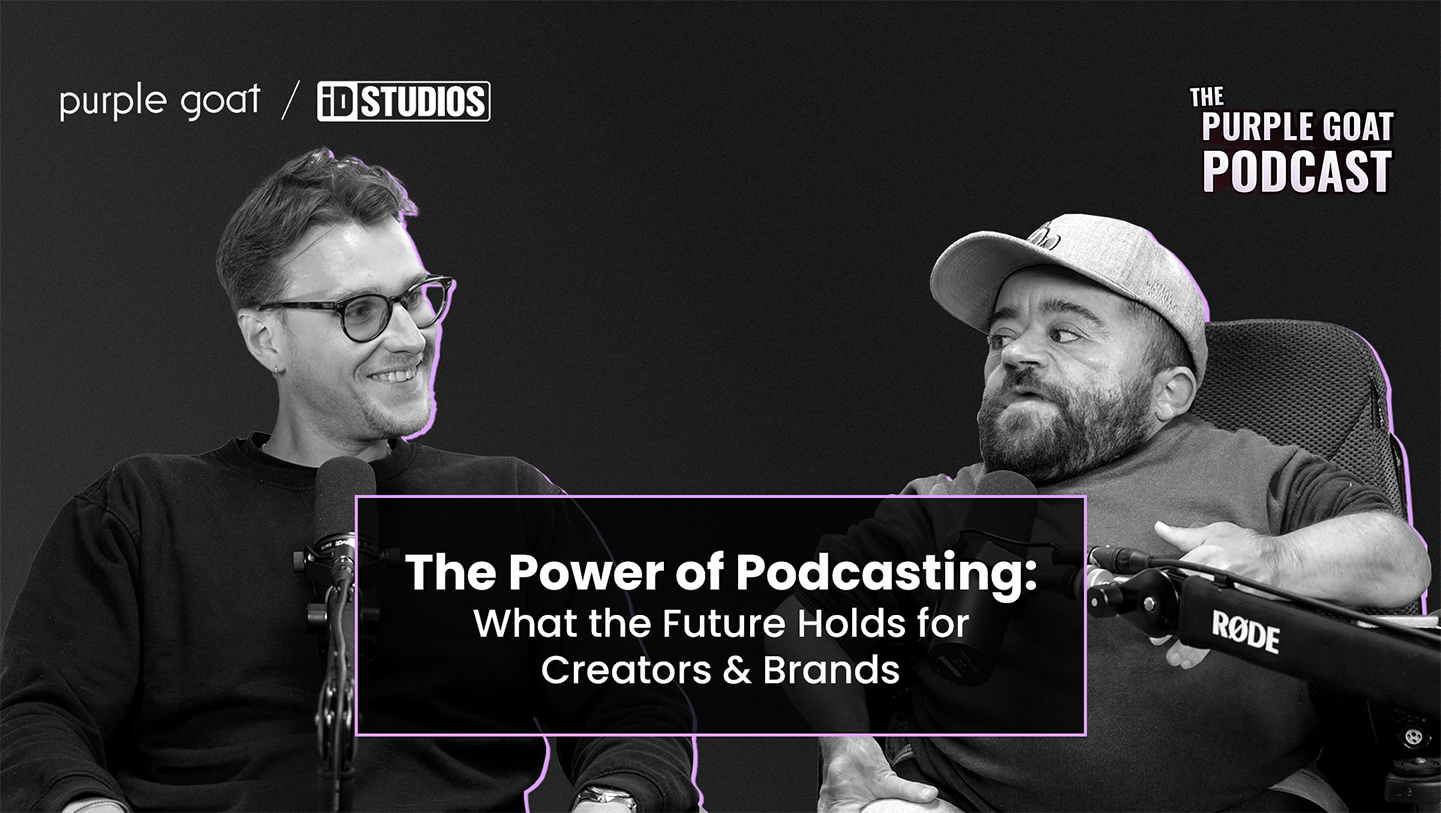
A few episodes ago we chatted with Jordan Pollock, Co-Founder of iD Studios in London. We dived deep into the podcasting industry, the ROI for brands, his advice for best in class content, and the future of the media industry. A really exciting one, we hope you’ll enjoy it.
{Transcript below}
Jordan Pollock:
When you have loyal listeners to your podcast, it’s much more valuable than just a standard CPM on a campaign because those people watching, they’re more than brand advocates and brand ambassadors. They are your hardcore fans. And I think for smart marketers, I think that gives you an opportunity to tap into niche audiences.
For us, the values of which we want to build ID Studios on, inclusivity is a huge part of that.
Go on YouTube now, look at some of the biggest creators in the world. It’s people from all walks of life, all different challenges, all different sexualities, disabilities, anything like that. And for us to really kind of have the physical space that represents the ID Studio’s mantra, it was really important.
Dom Hyams:
Having a kind of attitude of inclusivity, obviously transcends physical access, and that I think for us is also something that is just so fundamental and so evident.
Dom Hyams:
Hello and welcome back to The Purple Goat Podcast.
Today we’ve got a very special episode because we are with Jordan from this very ID Studio, to talk about all things podcasting, all things ID Studio, and looking into the future of media as well and what that looks like too. Jordan, thank you very much indeed for having us. Yeah, for having us.
Jordan Pollock:
Well Dom, thanks very much for having me as well. Nice to be here.
Dom Hyams:
Oh yeah, no, absolute pleasure. I’m very excited to chat with you today. I think that ever since we were first in contact with one another, there seemed like a lot of natural shared sentiment around what we do, the industry we’re in, and obviously opportunities into the future.
So I’m very excited to pick your brain, hear about you, your journey, and then also look to the future in what the industry might look like as well. Starting off then, would you mind just intro-ing yourself maybe, obviously intro-ing the studio and how that came to be?
Jordan Pollock:
Absolutely. So yeah, my name’s Jordan. We are here at ID Studios, which is the studios of which I’m a co-founder of. So we opened the studio I think 18 months ago now (this episode was filmed in 2024). We’re based in London Fields on Mare Street, which for those people who don’t know London Fields, it’s very much like a creative hub.
I’m sure when you guys come and visit, you’re kind of seeing all the different people here and it really is people from all walks of life and in all different industries. I remember when we originally looked around, we were looking at various different places to open the studio and some of our team who were with us, they were kind of looking around and they’re like, oh my god, that’s this person and that’s that person. And it was like some of the biggest YouTubers in the world we’re all working from this office right here.
So we were like, okay, cool. We feel that kind of creative energy that’s really important for us, but also for our clients. And we decided to open the studios here. And outside of that I’ve also co-founded a sports media agency. So yeah, it’s certainly keeping me busy, Dom.
Dom Hyams:
And what made you want to get into the kind of ID Studio podcast space as it were?
Jodan Pollock:
Good question.
One of the premises and the lines behind ID studios, more a mantra than a line, is ‘for creators by creators’. So long before we ever even dreamed of opening up a studio, we used to produce our own podcast.
So for eight, nine years I was a producer for a podcast, sort of as a side gig, and we’ve been across London, all the different studios and it was just, we never found a single place that could cater for our needs and that could kind of provide us with a premium looking sort of studio and all great equipment and use of studio really easy. We couldn’t find it.
So we were fortunate enough when we formed our new business that we had some really great investors, shut out KHI, and we kind of told them the vision and when we built the studio, I look around the studio and I feel a lot of pride for how it is, but this was literally a blank canvas.
So I was here rolling the floor out, all the set that you can see and kind of the other side. We literally, that was just blank pieces of wood that we literally, we got set builders in. We built it all from scratch. And I think that kind of ‘for creators by creators’ is because we feel like we are our clients, we understand the needs and the wants of people who are looking to do a podcast. And we felt like that put us in a good position for people who are going to be able to host their own podcast and build their own studio.
Dom Hyams:
And obviously with that kind of mantra around creators in the same sense, we live and breathe creators all day, every day, what we do at Purple Goat. What is it about creators as a kind of community that you think offer something that you can’t get elsewhere? What do creators offer brands, offer the general population, that is hard to get in other realms of marketing?
Jordan Pollock:
I think the growth of socials has allowed people to foster and build these communities of like-minded individuals, people who share the same passion points or any kind of particular interests.
And I think by being a creator who wants to really build their audience and mobilise their audience, and that could be an individual YouTuber or that could be an agency such as yourselves, it allows you to actually speak directly to either your consumer or your fans or your followers. And I think it’s so much more impactful to actually be able to show yourself and to share your beliefs and your visions and that’s going to build your audiences, which ultimately is paramount to a creator achieving any success.
And for yourself, working with different brands and working with different influencers, we all know sometimes it’s not just like social followings can be a vanity number, just because someone might have 2 million followers, the level of engagement that they get might be nothing. The connection people feel might not be anything. So sometimes even if you’ve got a smaller audience, but that audience will really believe you and go on that journey with you, then I think that’s being able to harness that is really valuable.
Dom Hyams:
And so therefore, podcasting and studios, sort of what I’ll call high production content, such as what you can do here, what has that offered to creators, what does that offer to the creators that walk in the studio and what are they able to achieve through that type of content opposed to what we might say your UGC content?
Jordan Pollock:
I guess just before we started rolling, we were having a really good conversation about this, so I would almost put it back to you Dom, and for Purple Goat’s perspective, what have you got out of using the studio comparatively with not?
Dom Hyams:
Good twist of events there.
Very honestly, I think that of course, both have a time and a place, and largely speaking, I think that for us, we love the sort of vehicle of the podcast to have a more nuanced conversation, often to have a very informal conversation and get under the skin of something in a really kind of effective way.
So often we talk about things particularly in the world of inclusion as not being black and white and not being like, oh, you can’t just kind of summarise everything that you want to talk about in 20 second reel or 30 second reel. So actually in that sense, the vehicle of the podcast is wonderful because we can show the actual personality behind individuals, the nuance behind a conversation, but different sides of an argument or not an argument, but the conversation. And so that’s in that sense, brilliant.
You’ve also got the very media focused value of it, and we do a 20 minute, half hour, 40 minute podcast and then we can chop that up into social assets. So we’ll do reels, we’ll do shorts, we do stills even sometimes, and all of that we can put out for in either trailing content that we’re about to do, or afterwards getting it a second life, or even third life across different platforms.
And it’s just extremely valuable for us to be able to do that. And more than anything, our content has to practise what we preach to our clients and obviously to our community, but we want our content to feel professional, we want it to feel interesting, we want it to be thought leadership, I suppose, because we want to carry that progressive conversation around both disability inclusion but also just broadly inclusive.
We know that we’re leading the way with that regard in many spheres of society, and so therefore it’s really important for us that actually we’re practising what we preach and producing that best in class content.
Jordan Pollock:
A hundred percent. And I think you said as well, prior to us starting the cameras rolling, that you can kind of showcase potential clients, the actual work you create for Purple Goat and it’s kind of like, hey guys, look, here it is. Here’s us doing it.
Dom Hyams:
If we can’t showcase what we’re telling them to do and to invest in, and we’re not practising what we preach and saying like, hey, this is the best kind of thing to get you ingratiated with a certain community, or to get under the skin of a certain kind of conversation, or whatever it might be, and we’re not doing that ourselves, I think that would look a bit strange.
And we are so passionate about the value of crafting what I’ll call, both engaging but also to an extent educational content, that really just builds a confidence in our audience and we still have to build that confidence in our clients, particularly if we’re again doing this kind of inclusive-first stuff, because we know it’s new to them, we know it’s different, but when we sit in a studio like this, we propose media that is familiar to them, suddenly we’re taken away that fear we’re taking away that, I suppose, worry that disability is going to look a certain way, and absolutely it is going to have total parity to what they’re doing elsewhere.
And actually we know it’s going to outperform what they’re doing elsewhere because inclusive narratives just do really work. So actually us being able to showcase what we do, actually have so much value for us.
Jordan Pollock:
It makes me very happy as the co-founder of the studios to hear that.
Dom Hyams:
And I think for you, it’d be lovely to hear a bit about the different types of clients you have in here and how that’s changed over time, and then also how you are imagining that moving into the future.
Jordan Pollock:
So I guess one of the best things about ID studios, and probably any podcast studio up and down the country, not that there are that many, is when you think podcasting, if I said podcasting, what would you picture? Who do you think of when you think of podcasting?
Dom Hyams:
Well, that’s a good question. I think of Steven Bartlett, or someone like that I suppose, because that now is just such a sort of household podcast that everyone sees somewhere and they have heard these stories about certain people that he’s interviewing.
I think that’s obviously very British, but you’ve obviously got your Joe Rogans and whatever that have just transcended something that would typically be a sort of infomercial podcast and have just become absolute mass media.
Jordan Pollock:
And mass media is the right term for that.
And I guess that’s kind of interesting because you kind of got that spectrum of podcasters, these kind of global thought leaders, mass audiences, huge influence. And then you’ve kind of got all the spectrum.
So like you were talking about from a Purple Goat perspective, you’ve got agencies, PR agencies, production agencies, marketing agencies, advertising agencies all coming in and producing.
Again, let’s say Purple Goat perspective, you’ve got B2C content that you’re putting out, but you’ve also kind of got the B2B content that you’re creating as well. You have, as we are looking at the other side of the studio, we’ve got the broadcast suite for the people watching on the cameras behind us. And that’s our second set.
And it’s currently showing many hipster and expensive football shirts and the flags of all the different Euros countries. So we’ve got a football podcast who come in and they record live every day. We’ve got Formula E, they come in. So we had the Formula E Champion he was in recently, so that was nice to meet him. We’ve had some of the biggest rappers in the UK.
I just got back from Glastonbury where I saw Mr. Mike Skinner, and it was very cool. We had Mike in the studio.
Dom Hyams:
Amazing. I met him once at a festival in Denmark and genuinely to this day I would say it’s the best gig I’ve ever been to.
Jordan Pollock:
Oh really?
Dom Hyams:
It was a streets gig at Ross Gilder Festival. Very cool. He just had 80,000 people in the palm of his hand and it was just unbelievable to see that kind of ability to work a crowd in that way. It was just phenomenal.
Jordan Pollock:
Absolutely.
Dom Hyams:
Phenomenal.
Jordan Pollock:
I can confirm he was phenomenal at Glastonbury as well.
But yeah, so you get such a broad spectrum of people who come into the studio, and I would say big shout out to Gearoid, who’s our main studio engineer here. He’s always working on the studio tirelessly. He sees more celebrities than probably anyone else in London, because it’s like a conveyor belt of interesting different people who come through. So he’s in the hot seat there welcoming them in.
But yeah, it’s brilliant. It keeps things super exciting.
And then you also kind of go down to people who are starting out their podcasting journey. So I mean, we’ve worked with so many different people, and even in terms of ideation of their podcast, so we’ve been working with a professional boxer, a world champion called Chris Billum Smith, who’s sort of a growing name, but big enough to have headlined a couple of football stadiums. He came to us with a concept and he said, listen, I want to have this whole podcast kind of based on that 1% of that push yourself to that 1% to really maximise your performance. It’s kind of his mantra, CBS consistency, build success. And we basically ideated how he could leverage his brand and his audience and put it into a digestible kind of podcast and how he could grow his audience like that.
So yeah, lots of different people.
Dom Hyams:
Amazing.
Dom Hyams:
And looking towards the future, what do you see for the industry? Do you think that we’re getting to a point of saturation or do you think that it’s just going to continue growing and growing and growing as an industry?
Jordan Pollock:
I don’t think from a UK perspective, I don’t think we’ve scratched the surface. When you look at how the podcasting industry operates in the US, it is night and day compared to the UK.
I mean just the scale of it, obviously you’ve got big audiences there, so there’s much more marketing dollars over there. But I even think in terms of the way the London Podcast Show, which I don’t know if you’ve ever been to before, but it’s really interesting, you kind of get your big behemoth, your Acaster, etc down.
And Louis Theroux was there last year and that’s really inspiring when you go to an event like that because you feel like you can see this community coming together, and you can also see the scale of it. I think when you look at the development of social media platforms, like even YouTube for example, having a specified podcast set, obviously Spotify bringing in video, it’s never been more important to have cameras rolling as well.
Obviously when you are looking to cross-pollinate your content across different platforms, it’s essential. So I do just see it growing, growing. I mean TikTok, god, it’s dangerous when you get on TikTok, you get on there and I mean time moves very fast when you’re on TikTok, doom scrolling for hours, keep scrolling for a long time. But how often do you scroll through there and you see clips from podcasts that you’ve never seen or ever heard of before?
Dom Hyams:
That starts you on your journey.
Jordan Pollock:
And I think there’s a long way to go because, don’t get me wrong, it’s not easy to monetise a podcast. Now you’re seeing it more and more. There’s certain brands who will do different deals with the major publishers, et cetera, and you’ll get a blanket CPM, but it’s really evolving now.
And I think when you have loyal listeners to your podcast, it’s much more valuable than just a standard CPM on a campaign because those people watching, they’re more than brand advocates and brand ambassadors. They are your hardcore fans. And I think for smart marketers, I think that gives you an opportunity to tap into niche audiences.
And I think because of that, because of the ROI, people will get on that, I think you’ll see more money coming into the industry that paired with the development of social platforms. I think it’ll all rise up together.
And I think ease as well. If you wanted to start a podcast 10 years ago, it was quite difficult to do it and now you can. I wouldn’t recommend doing it on Zoom, come to ID studios, but you can do it for free if you want to. And that’s okay as well. So onwards and upwards. I hope, but also we’ll see.
Dom Hyams:
You sort of mentioned briefly there around the financial opportunities, but also obviously some kind of barriers to podcasting as a moneymaking thing for some people. What would your top tips be for aspiring creators in terms of they want podcasting to be a big remit of their content, they’d love that to pay for itself and monetise for them. What would be your top tips based on what you see that works best in terms of how they approach it?
Jordan Pollock:
Patience and consistency.
That is what I would say because it takes time to build an audience. So just because you might have a preexisting audience on one platform doesn’t mean you can always translate that into an audience on another platform. So it will take time.
And I would also say you want to do something that you really care about because if you are going to be the person sitting there talking about it, week in and week out with that consistency, if you are not interested, your viewer knows that. So you have to really live it and breathe it. And I think if you want to do it for a moneymaking kind of scheme or a revenue driver, there’s easier ways to make money. But once you do crack it, then I think the possibilities are endless.
Dom Hyams:
And the ability to then branch out, differentiate revenue streams from there can be also very lucrative as well.
Jordan Pollock:
Yeah, a hundred percent.
Dom Hyams:
In terms of you as a businessman, you look into the future, what are your aspirations for ID studio and beyond?
Jordan Pollock:
I think for, I kind of alluded to it at the top of the podcast, but podcast studios in London are fairly few and far between. The big differentiator we wanted to have at ID studios within London was to have that industry leading equipment. So it was all about providing a premium service.
So you come into the building, it’s a really lovely building, there’s a great cafe downstairs, you come into the actual studio and we’ve tried to design it as nicely as possible. We’ve taken a lot of different support and we want to have a set on camera that looks amazing. And that was one of the things we always found. It was kind of sofa plunked in front of wall. We didn’t want to do that. These windows, for example, this was a very last minute change before we opened the studios, that ended up delaying the opening of the studio by about a month, because we were originally having the lounge set was going to be on that back wall, but I didn’t want to lose the brick.
So we built these custom flats, we filled this with LED lighting and then put these fake windows in so you could customise the colour, put it to your branding, make it look personal. It’s all about personalisation.
I’m going slightly off tangent there, but for the future of ID studios is to open more studios. So I think what you’re seeing is there’s different cities, Manchester, Leeds, which are huge, huge creative places. And I think what you’re seeing is slowly, slowly, things like podcast studios are becoming more accessible and becoming more desirable.
And I think for us trying to be there to cater those needs at a competitive price point with industry leading technology and the staff and the service to have a nice premium experience is exactly what we’re there to do. So hopefully we’re only new, we’re only young, but as we build our audiences and make sure we maintain that service, that would be the ambition for ID studios.
Dom Hyams:
Awesome. Good luck with it.
Jordan Pollock:
Thank you very much.
Dom Hyams:
And I think just to, I suppose wrap things up to an extent, we obviously came to you because for us the accessibility and inclusivity of the space is fundamentally important. I’m a wheelchair user, other members of the team are wheelchair users, so physical access is one thing, but then it’s like does it have an accessible loo? Is there enough space, does it have a lift?
I mean they sound like quite basic things, but you’d be amazed how few and far between those are for looking at podcasting spaces, studio spaces in and around London, and of course beyond. And I’m guessing that London will be best in class for that. And as you get further and far between, that isn’t something that you see that often.
I think that it’d be great when we first spoke to you, you can tell when you meet someone that they get it and you just got it and understood that. Have you had any sort of thinking in and around that when you were building the space or is that just something that happened to be the way that things are as far as ID studios is concerned? And is it something that you hope to bring forward into the future as well?
Jordan Pollock:
I think, well, just to echo some of the things you said. Yes, likewise. When we had our conversation, I was kind of really excited to work with yourself and work with your team. And I think when we looked, because we must have done well, we looked at a lot of buildings, a lot of different places for a studio, and for us and the values of which we want to build ID studios on, inclusivity is a huge part of that.
Again, just to say for creators by creators, go on YouTube now look at some of the biggest creators in the world. It’s people from all walks of life, all different challenges, all different sexualities, disabilities, anything like that. And for us to really kind of have the physical space that represents the ID studio’s mantra, it was really important.
And this studio as well, Mare Street Studio is where we are, is a workspace building called Mare Street Studios. And it’s also one of the greenest buildings, sort of communal workspace buildings in London. So that kind of fit with us as well.
Obviously you’re talking about the wheelchair access, we’ve got the lifts that just come straight up. There’s no stairs really here. Super important. And I think as we kind of grow and look to other destinations, et cetera, absolutely. And with podcasting, like I said before, there’s so many different people and all the guests that different people have, you have to really be able to think about things like that in order to try and build a sustainable business.
Dom Hyams:
I mean, it sounds so fundamental, but we obviously just have to look through the lens of, well, we could have anyone come as a guest and we know that their needs are going to be diverse, so therefore we know that we therefore need a studio that can accommodate a diversity of people’s needs.
But at the same time also had that attitude to try and be helpful to that as well. We know that it’s not one size fits all. It’s not everyone needs that one thing and that’s it. Having a kind of attitude of inclusivity obviously transcends physical access and that I think for us is also something that is just so fundamental and so evident with you guys as well.
If we came to you with a specific kind of ask or a specific request, I know that there’s an opportunity that we could try and work that out. We’ll do our damnedest to make it happen. And that is so refreshing.
Again, it’s not something that you see every day, that you still do get that kind of computer says no attitude sometimes. And it’s so nice when you work with people and collaborate with people where actually it’s like, no, we’ll just make it happen and do it. And that’s really, really fun.
Jordan Pollock:
Well, it’s lovely to hear that, so I appreciate that. Thank you. And again, I shouted him out earlier, but shout out to Gearoid because he’s an absolute cornerstone of this business. So yeah, a lot of your comms are with him, so yeah.
Dom Hyams:
You had two shout outs in one podcast, Gearoid, there you go.
Jordan Pollock:
Well, his mom slipped me 50.
Dom Hyams:
No, I echo that. Absolutely.
Honestly, thank you so much for all your support of The Purple Goat Podcast. I’m obviously very excited as to where our relationship will go into the future and what we can do together. I’m sure there’s a load of exciting stuff on the horizon, the very best of luck with everything.
Is there anything you’d kind of like to end on to our audience? Anything you’d like to say?
Jordan Pollock:
Nothing jumping out at me, but yeah, Dom, thanks very much. I was looking forward to our conversation today. Every time we’ve spoken before, I’ve found it really interesting and I really respect what Purple Goat are doing and I think how you do it is so fantastic as well. I think your team has been lovely, Carmen, so it’s been nice to get to know yourself and your team.
And yeah, if you are looking to book your podcast ID studios, we’re only eight minutes from Liverpool Street.
Dom Hyams:
Awesome. Great plug in the end.
Jordan Pollock:
Thank you.
Dom Hyams:
Have a lovely day. Thanks mate.
Jordan Pollock:
Thank you very much.