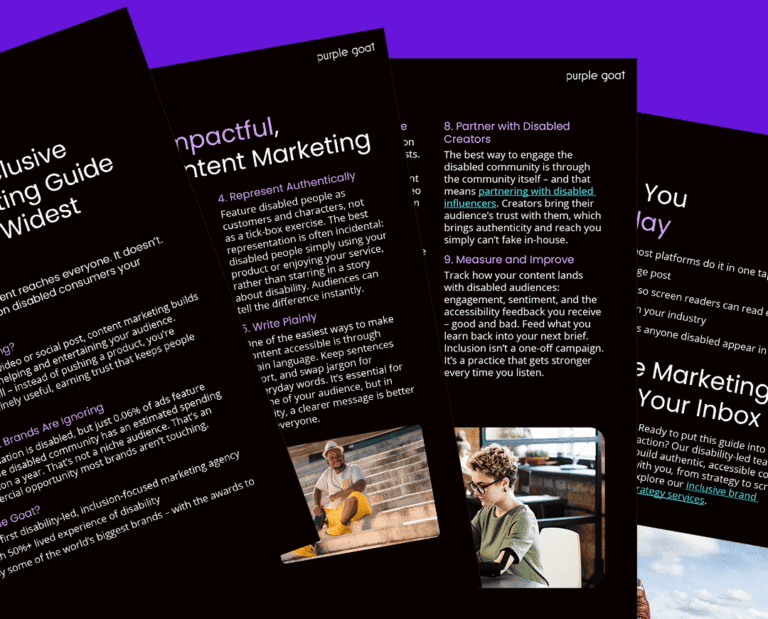
The Ultimate Inclusive Content Marketing Guide: Download Now
Learn how to create content that reaches your widest audience yet.

Accessible holidays are having the moment they deserve, and TUI is leading the conversation in the industry, while creating real change for Disabled consumers.
But accessibility isn’t just good for some people. Everyone benefits from accessible holidays.
How can brands create more accessible experiences to customers? And what can they learn from TUI’s award-winning work and their collaboration with inclusive marketing experts, Purple Goat?
Check out this episode with TUI’s Accessibility Manager, Marina Snellenberg, and Purple Goat’s Founder, Martyn Sibley.
{Transcript below}
Martyn Sibley:
I’m not looking to go on a disabled holiday. I want to go on a holiday with my friends, my family, that I can trust is accessible.
I mean, it’s such a big topic, isn’t it? As we know, if you look at the pure accessibility conversation, we know the numbers like 15 or 16 million disabled people in the UK, 1.3 billion people globally. So the community size is vast.
Marina Snellenberg:
The multiple aspects of disability, and the different type of need, is too vast to try and put a logo that defines accessibility, a stamp.
So we’ve taken the approach at TUI that we give you as much information as possible, and then you make a decision on that.
We’re removing this idea that accessible holidays is a close product, and this is what it is, this is the box, these are the holidays you can go on as a disabled person, and more making it part of the mainstream offering. So it’s embedded in what you do as a non-specialist travel provider, which is what we are at TUI.
Martyn Sibley:
Hello everyone, and welcome to the latest episode of The Purple Goat Podcast, one that I very readily signed up to present and be involved in because it’s on my big passion topic of travel.
And today I’m being joined by Marina from TUI, who is a brand, a client, we’ve been working with at Purple Goat, but also someone that we’ve known each other a long, long time. We’re saying for about seven years now. Really that sort of looking at before bigger brands where as aware of or as sensitive to disability and accessibility. And we’ve both been on a career journey that brought us back to have this chat today, which is really exciting.
So thank you for joining us.
Marina Snellenberg:
Thank you for having me.
Martyn Sibley:
And would you like to just give a little backstory then?
Marina Snellenberg:
Of course. Yeah, absolutely.
So I’m Marina Snellenberg and I am the Accessibility Manager for TUI UK, and I head the accessibility strategy and really laser focus on making it easy for everyone really to go on the holiday that’s right for them, whatever their needs, and that’s what we do.
Martyn Sibley:
Yeah, I mean it’s such a big topic isn’t it? As we know, if you look at the pure accessibility conversation, we know the numbers are like 15 or 16 million disabled people in the UK, 1.3 billion people globally.
So the community size is vast, but then there’s the sort of sub communities from the disability perspective, as in like I’m in a wheelchair so I’m parts of that community, but then the barriers I face are very different from someone who is deaf or hard of hearing or blind or visually impaired. So there’s those variables and then there’s the general holiday variables.
We’re talking about holidays and travel. Some people love beach holidays, some people love skiing, all sorts of other things. So how do you, through the work you’ve done for a long while and now with TUI as well, how do you get your head around all these variables?
Marina Snellenberg:
I suppose it’s by taking out the idea, or removing this idea, that accessible holidays is a close product, and this is what it is, this is the box, these are the holidays you can go on as a disabled person. And more making it part of the mainstream offering. So it’s embedded in what you do as a non-specialist travel provider, which is what we are at TUI.
Rather than just like these are the yes hotels and these are the no hotels. That kind of idea of everything. As long as you have the right information, everything can be made somewhat accessible, as long as you are, as customer, you are made aware of different things that are important for you and for your access needs.
Martyn Sibley:
Yeah, I guess for me, two things that jump out. There’s the product or the service but the offering. And so I know there’s a lot of work goes on in the background about how to vet what barriers exist, how to overcome barriers within the different segments of the disability community.
And then the one thing you said there is about information. So I don’t know if either of those jumped to you, but it’d be great if you could speak a bit more to those two specific points of the product and the information, and things you’ve been doing at TUI to help address that as well.
Marina Snellenberg:
So there’s a lot about how specifically for TUI is we deal a lot with the local legislation of okay, how many accessible rooms you have to have when you have a hundred rooms in a hotel. So we need to deal with that aspect of it, we need to whatever, we can set some standards and give some guidance as to what will be the best solution for a hotel that maximises accessibility.
Martyn Sibley:
Because you don’t actually always own the hotel, is that correct?
Marina Snellenberg:
That’s very true. Sometimes we just contract some rooms and we want to give as much choice as possible. So we do that for hundreds and hundreds of hotels.
But in some other cases, yes there is a bit of room to actually look at, okay, how can we make that more accessible? And we’ve started on that journey as well. We make things like Sunflower Lanyard training available for hoteliers, and provide some guidance after our work with detailed access guide is published then go back to hotels and say this is what your guide looks like and this is what you could do to make small improvements.
The majority of them don’t cost anything or very little investment, but the piece around information is very, very key. And until we realise that we can’t do this on our own, that we need specialised knowledge, that we need someone to harness all that information and publish it and make it available to customers and vet the information as well.
We do that through AccessAble, who are great partners of ours and they’ve been on this journey with ours. Then when we reach that point we were like, okay, this is how we do it, this is how we do it. Because otherwise you’re forever relying on what a hotel tells you or what someone else’s opinion is, and as you’ve just said, the multiple aspects of disability and the different type of need is just is too vast to try and put a logo that defines accessibility, a stamp.
So we’ve taken the approach to that we give you as much information as possible and then you make a decision on that.
Martyn Sibley:
Yeah, that’s a great way, isn’t it?
I know for me as a disabled person, when I used to see marketing of disabled holidays, accessible holidays, it was a strange feeling because on the one hand it’s better that they were existing than nothing, and the fact that there’s an element of verification, et cetera, but also I’m not looking to go on a disabled holiday. I want to go on a holiday with my friends, my family that I can trust is accessible.
And so I think that’s been a big shift we’ve seen in the industry that it’s moving, as you said quite rightly earlier to it’s holidays that we all love to go on and then here’s the information and then the individual can make that judgement call. But obviously can’t we as a customer, as a disabled person, can’t make the judgement call without that amount of information. And that feels like a big improvement that that’s been providing AccessAble, they’re doing some great work as well.
So it’s great. We give them a shout out as well.
Marina Snellenberg:
Absolutely. We love working with them.
We have recently launched the new accessibility filter on our website, so as well as looking for your dates and airports and your board, your number of star rating for your hotel, you now can filter your search for hotels that have that information, that detail access guide information.
So we are making it easier to actually find the right holiday to start with, and then we want to make it easier to go on that holiday as well. But that’s something we are very proud because we’ve just integrated it within everything else so you can filter through everything else as well as accessibility information available. So yeah, that’s great.
Martyn Sibley:
That filter point sparks a bit of a memory, because you’ll remember before Purple Goat, I co-founded Accomable, which was essentially, it was doing kind of filtering of accommodations but not the full tour operating that TUI does. It was purely accommodation and Airbnb acquired Accomable. So all of the filters that are on Airbnb are legacy really of that.
Martyn Sibley:
The challenge that I think was found in that model, and you kind of referenced it earlier, is you are asking others to upload the information. And so I am not just calling out Airbnb, it’s a challenge and all the different services, but I go on and I tick wheelchair accessible for example on a filter and hundreds could come up in the place I’m looking. But as you and I know sometimes you go to the destination, you arrive, I think it happened to me once in Tenerife, I got to the supposedly wheelchair accessible place and it was steps to get in and that was where the individual owner of that property had incorrectly listed it, which caused quite a big problem for myself and others.
So yeah, I think that kind of empowering people on the supply side, the hotel side is fine, but there needs to be that stringency and that checking that the information is correct as well.
Marina Snellenberg:
Yes. And also honestly that if you don’t have the information say, so the AccessAble project with TUI is a very small percentage of our portfolio, that’s okay, that’s where we start.
And for anywhere else where we don’t have that information, we’ll make it clear that we don’t have that information. So then you can decide, do I want to inquire more about this unit, this hotel, this resort, or do I stick to the resorts that have the information? But honesty is the key.
Or you can even say this information has been provided by the supplier directly, or just be honest with how is that information vetted so then people can make decisions.
Martyn Sibley:
Yeah, brilliant.
Martyn Sibley:
So I suppose Purple Goat, we’re a marketing agency. First of all, I want to say it’s just so cool we’re working together. It’s like a dream come true after all our chats for so long.
With Purple Goat, the initial offering, and still very core offering, is around content, influencer, social media, and we were talking earlier today as well, how there’s absolutely the need when a product or service and the information is ready, then of course brands should be going and singing about it.
But I think what we’ve found in travel and other industries is that that bit has to be relatively – perfection is a hard one to go for. So let’s not stop making moves either, waiting for perfection.
But those things you’ve just spoken about are fundamentally important before you want to start getting customers to come and book, right?
Marina Snellenberg:
Exactly.
Martyn Sibley:
That’s obviously where we saw the benefit of the insights side. So the roundtables and the surveys, and we talk a lot about bridging you and I, actually, whether it’s brands and disabled customers, but it’ll come onto the supply chain later as well. But in the end it’s just trying to bridge and bring everyone together for the overall purpose, which in this instance is accessible holidays really.
So yeah, I think with that insights, that’s some of the work we’ve done together. What did that mean for TUI? What was the benefit of getting to meet and hear unfiltered feedback from the community and how is that valuable for you?
Marina Snellenberg:
It’s incredibly valuable because we don’t want to make the mistake that we are just listening to ourselves, like inwardly.
The world of disability, the world of accessible travel, is so fast pacing. I started in this role eight years ago and it’s already changed dramatically, the language around it as well. What was okay to say before is not so much, the community have spoken and said no, we are going to use these terms or we are going to move away from those. So we need to keep up with that.
And we are always looking in, looking at our own data on our research, our own research, which is very valid. We should do that always. We should always listen to the feedback. But when you start looking outside then you see, oh, what else is happening? How are we perceived outside of this little bubble? And doing the panels, we call them external forum because we have an internal forum, but now we have the external forum, has been great.
So many great ideas, we’ve taken some forward already. Some others we are looking just how can we expand. And it’s just been really nice to have that sounding board of, are we on the right track here, are we missing something? It’s nice to have validation, but it’s also nice to have a bit of challenge and say, okay, we thought we were all right with this, but maybe we need to revisit this opinion. So it’s really good.
And then the research piece that Purple Goat did for us has been really good because research in the accessible travel industry is very, very scarce, so we need to really invest into that. But it was nice to have some numbers behind what we felt were our opinions and now we have proven evidence of the different trends. So it’s amazing.
Martyn Sibley:
Great to hear. And I know Dom and I, on the last podcast that we did together, spoke about that need to hear from the community in the sense that Dom and I spoke earlier about the kind of sub communities.
So Dom and I are both wheelchair users, but we’ve learned so much, not just from the other disability sub communities, but even from other wheelchair users because everyone has different experiences. And so I think we’re all, and I think when you spoke to that leadership and that openness to take on feedback and change and evolve is easy to speak about in a podcast, but everyone at any brand will know it’s easier said than done. So yeah, huge testament that you’ve been able as an organisation to do that, really.
Marina Snellenberg:
Yes, I think you have to be open because if you’re not, then you set on this path of like, okay, this is what we are going to be doing and this is what we are going to and once we’ve done it, that’s it. We’ve ticked the box, but this is not a box ticking exercise, this is a strategy, this is an ambition that we have and we need to be able to mould to it because otherwise we’re going to be obsolete within three years and we don’t want the accessibility strategy to just disappear.
We want it to grow and evolve and really look around us and bring others with us as well. So unless we keep hearing from the community, we are involved with organisations and as many agencies as possible as well, then that’s when we get together agreed and make things happen.
Martyn Sibley:
Always, always.
So I guess a couple more points to touch on before we start to wrap. One is around the supply chain, and you can speak a bit more in the weeds than I can, but obviously TUI doesn’t have control over every part of a person’s holiday. So I guess just it’d be good to hear from you a bit more about that end to end part for people going on holidays.
And we all know, particularly with flying, there can be challenges, but just how you can navigate that, where you have some influence where you don’t, but it’d be good for people to hear a bit more about the supply chain side of a holiday really.
Marina Snellenberg:
Yeah, I mean we are lucky to that we own quite a few parts of the customer journey, all of the research and book we own, we have our own airlines, our own cruises, our own hotels, our own transfer companies, our own experience to amusement, our own experience part of the business as well.
But yes, there are times where our customers in their journey go into the hands of others. And that is hard because if we talk about an accessible holiday, an accessible experience from a customer perspective is going to be end to end.
So our job is to make sure that we, first of all, gather as much information from the customer, as well as giving the customer as much information as possible. We gather as much information as the customer is willing to give us in terms of what would make their holiday more accessible, is our job to pass on that information to as many people as possible, to double check, triple check that everything is booked and rebooked.
And then for those little gaps where we don’t have control, our job is to make sure that we work with those actors and we really bring them along in this accessibility journey and really highlight the impact they have when things don’t go to plan.
And I would say that it’s also my job as an accessibility manager to be part of the community of many other disability advocates and accessibility managers in the travel industry to ask agencies and organisations to work together and to find common solutions, common ideas, put forward best practise and share the good work as well as highlight when things don’t go to plan. Because otherwise we are working in isolation and that is never good for the customer.
Martyn Sibley:
Yeah, thank you for sharing that. And as we know, there’s complexities and there’s challenges, but again, I think spirit of collaboration, open dialogue is always going to be the one that gets us more forward.
Martyn Sibley:
The last point I wanted to touch on and give you a bit of space, if there’s anything you want to make sure we finish as well, but around influencer marketing and around content creators.
So we spoke a bit, there was, we’re not tick box as you said, but if we imagine that little checklist is that the compliance side, the product service side, supply chain, the information. So all that great work that’s been going on, but there has to be the point where there’s that open, guys, we’ve done all this work, we’d love you to come and enjoy the holiday with us and we’re still open to that feedback.
So I know I think we are in the middle of an influencer activation, but you referenced something to me earlier when we spoke about how positive that’s been for TUI. So it’d be great just if you could speak a little bit to that process of doing the influencer activation. I appreciate it’s partly with some of your colleagues in the marketing team as well. But anything you care to share around that would be really helpful.
Marina Snellenberg:
It is been really fun and it’s been really nice to, it’s like the little bow to all the work we’ve been doing of, we’ve worked so hard to gather all this content to put it on the website to make sure that everything works, and then for someone to go on and experience that and kind of highlight it in their social media as, this is possible, you can have an accessible holiday with TUI, this is what it looks like. And also this is what it doesn’t look like because we are not a specialist provider. It’s that honesty as well.
Martyn Sibley:
What it isn’t.
Marina Snellenberg:
Exactly, what it isn’t, but we can provide an accessible holiday for you.
It’s really nice to see it end to end and shown it in that positive light, and also to work with the feedback that we get. And yeah, it’s a representative media campaigns, and showing truthful experiences that are not manicured, that are authentic. It is the way forward. So we wanted to do that because it is a testament of the work done that we do that in that way.
Martyn Sibley:
And then we both observed there was quite that good sentiment from the community of acknowledge, and a couple of people saying they’re going to start looking into booking their next triip, which is good for TUI is a business and it wants to be able to grow the business or have customers basically. But from that mission perspective, it’s just great that more disabled people feel confident and empowered in their decisions around travel.
Marina Snellenberg:
I always say the same thing is, no one’s going to complain that your business, your organisation is too accessible. No one’s going to say, oh gosh, that was such an accessible holiday, I’m never going to do that again.
So if you can make others, you can show it to others that it’s possible, even if you are disabled or not, you’re going to connect with that feeling of like, gosh, it is something good in here and it may not apply to me, but it may apply to someone else in my family or maybe it apply to me in the future. So it is just that idea that accessibility is good for all.
Martyn Sibley:
Beautifully.
I was going to ask if there was a final thought you want to leave everyone with on the topic. Does anything come to mind?
Marina Snellenberg:
No. But maybe I would like to ask you about the most accessible holiday experience you’ve had, if there has been any.
Martyn Sibley:
Yeah, I mean I think I spoke loads over the years, and other people have followed some of my travels, and we spoke a bit about the couple of not positive, particularly around flying. They stand out because they’re quite traumatic sometimes.
And I think there’s the flip side of that, the acknowledgement that lots of people do go away with a disability on holidays that tend to go well, and that doesn’t get the same kind of pickup in the media, or we just don’t, as humans, share the good as much as the bad.
So I kind of want to more broadly speak to, I’ve been away lots, I love travels, I’m in a wheelchair, I need care support hoist, but it’s all doable. I think that’s a big message for people that are not sure if it is possible and it can work well.
And I suppose practically to your question, it’s mostly going to places, I love a sunny beach, for example. And just knowing that all the things I need around access have been thought of, and as you say, been informed transparently to me so I don’t arrive and find that I can’t get in the apartment.
Marina Snellenberg:
Yeah, exactly.
Martyn Sibley:
So we could go off on all sorts of tangents, but I think that’s a sort of nice, as you say, a bow around a really good conversation.
Yeah, I think we’ve covered everything there, but thank you for your time.
Marina Snellenberg:
You’re very welcome. Good to catch up.
Martyn Sibley:
Of course. And everyone, thanks for watching and listening. Thanks to everyone at ID studios for hosting us today and we’ll see you next time.
Bye-bye for now.